

I’m a fan of Blackwing pencils. They’re high-quality (the graphite doesn’t crack, they sharpen well) and they have a rich history of famous people using them. In the past 15 years, Blackwing has released a bunch of themed pencils. I personally use the Joe DiMaggio #56 on my baseball scorecards.
Yesterday they sent out a one-day promo that I missed. (Which for me is fine, because I have enough Blackwing pencils to last me quite some time.) But the promo was pretty cool.
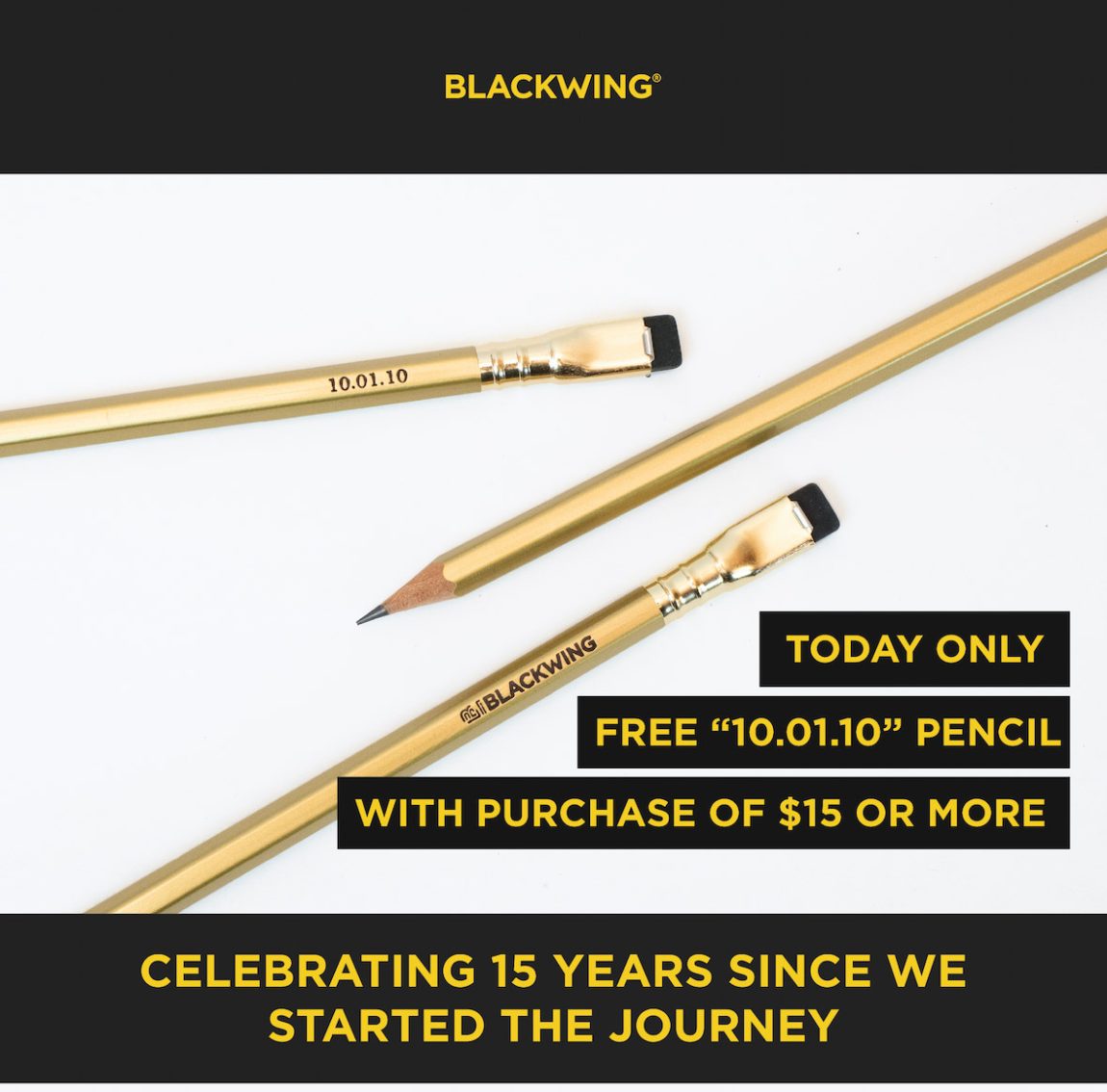
The barrel of the pencil is stamped with “10.01.10” in honor of October 1, 2010, the date Blackwing was relaunched 15 years ago.
Those digits looked really familiar. Like some sort of computer code. All binary 0s and 1s. I removed the dots and looked up what 100110 would be in binary: it converts to an ampersand (&). That’s pretty rad.
Whether Blackwing intended this or not, the ampersand feels surprisingly perfect for their brand. The ampersand is all about connection—it literally means “and.” And Blackwing is about connecting past & present (reviving a legendary pencil), art & writing (used by animators, composers, and authors), quality & accessibility (premium pencils at reasonable prices), and creativity & craftsmanship.
The ampersand also represents continuation, which fits a brand that brought back a discontinued icon and keeps adding new chapters to its story. Every limited edition pencil they release is another “&” in their narrative—Blackwing & Beethoven, Blackwing & the Muppets, Blackwing & baseball.
So maybe that binary code hidden in their anniversary date is the perfect accidental symbol: Blackwing is the “&” that connects all of us to better tools, richer history, and the joy of putting pencil to paper.
Technically, the exact translation in binary for an ampersand is 0100110, not 100110. For now, we’ll ignore that first zero.
A small encoding detail to add to the pencil connection: 100110 is decimal 38, the ASCII value for &. Leading zeroes do not change that value; as a full eight-bit byte it is 00100110. For anyone checking it with a byte-based decoder, that padded version is the one to paste. I work on another tool for trying these examples: https://binaryconverter.io/binary-to-text/ .