

September 1 is World Letter Writing Day, which most people celebrate, if they celebrate it at all, by writing a letter on paper. Everyone gets letters on paper. This year, write a letter on aluminum foil! I’m going to do it this year, please participate with me.
Here’s the backstory of how I started writing on aluminum foil. And how all this relates to art history.
On January 12, 2022, nowhere near any letter-writing holiday, I wrote to my friend Marco on a sheet of aluminum foil instead and dropped it in the mail. Foil is sitting in almost every kitchen in America right now, and as far as I can tell nobody has ever written a letter on it.
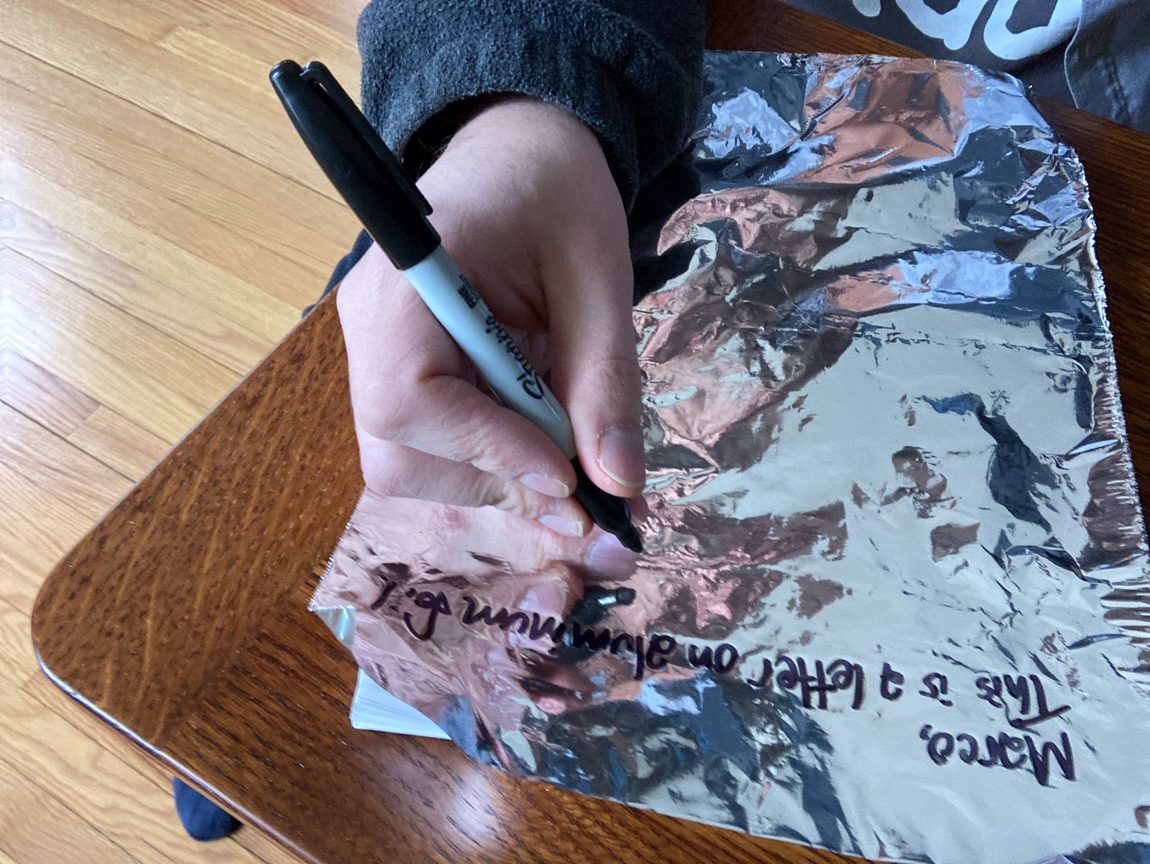
Foil is reflective, so while you write, your hand is down inside the writing surface along with the words it’s producing. Your face turns up back there too, depending on how you tilt the sheet. It’s a bit surreal.
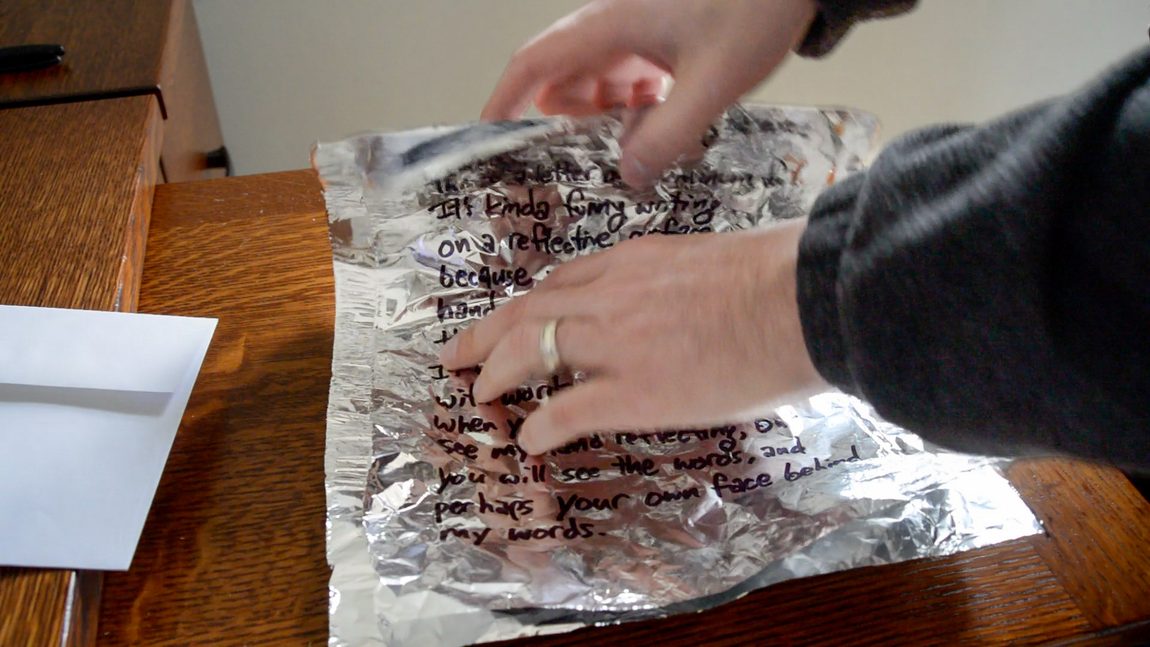
Then I folded it up and sent it away. Marco doesn’t see my face in that foil. He sees his own. The handwriting is mine, the words are mine, and the whole thing is addressed to him; but the reflection belongs to whoever happens to be holding it.
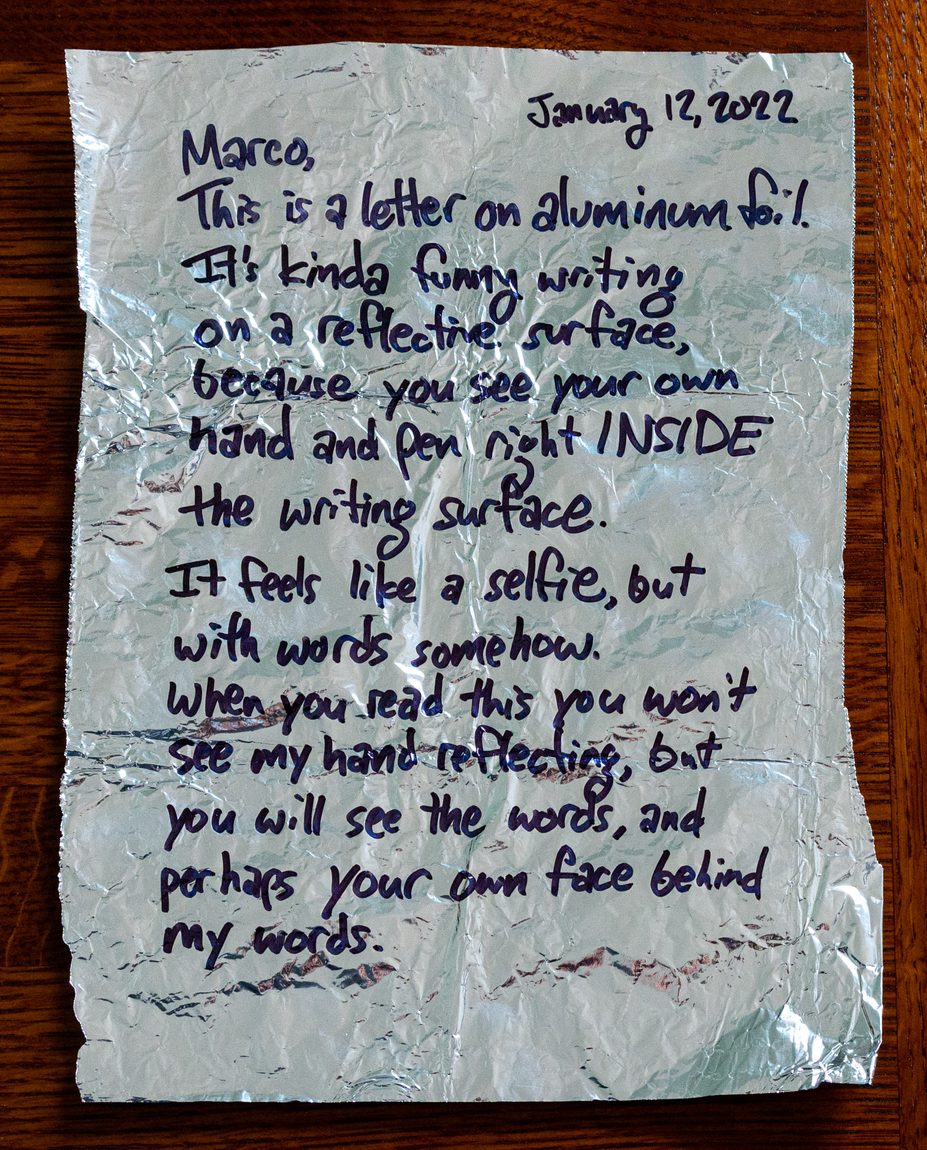
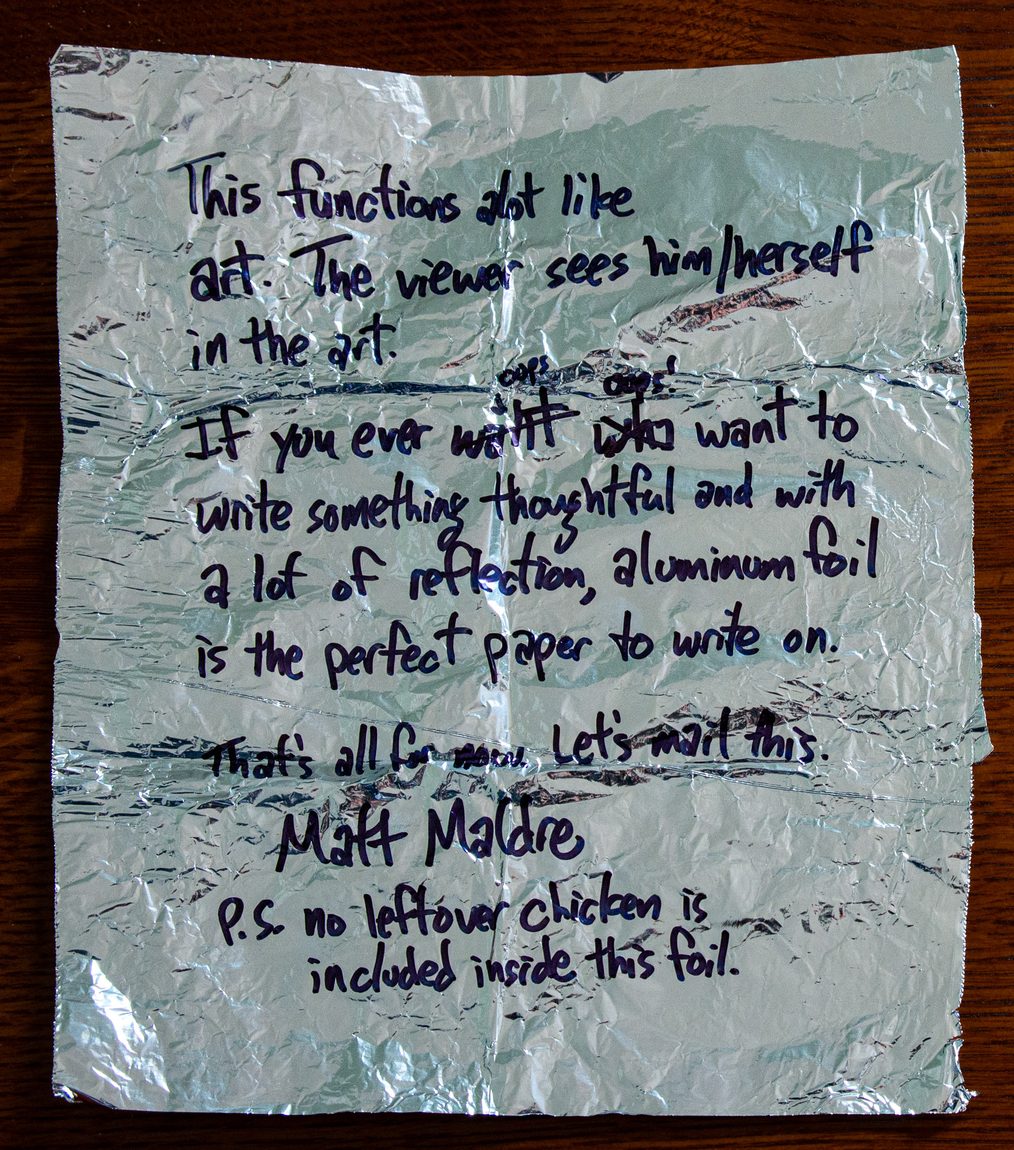
Now, how this wacky act can be seen in light of art history. A letter on aluminum foil turns the reader into the self-portrait.
The kitchen drawer and the pedestal
Marcel Duchamp is the first that comes to mind. Starting in the 1910s he took ordinary manufactured objects and presented them as art, and the Bicycle Wheel, the Bottle Rack, and Fountain all went after the assumption that an artwork has to be something an artist labored over with traditional skill.
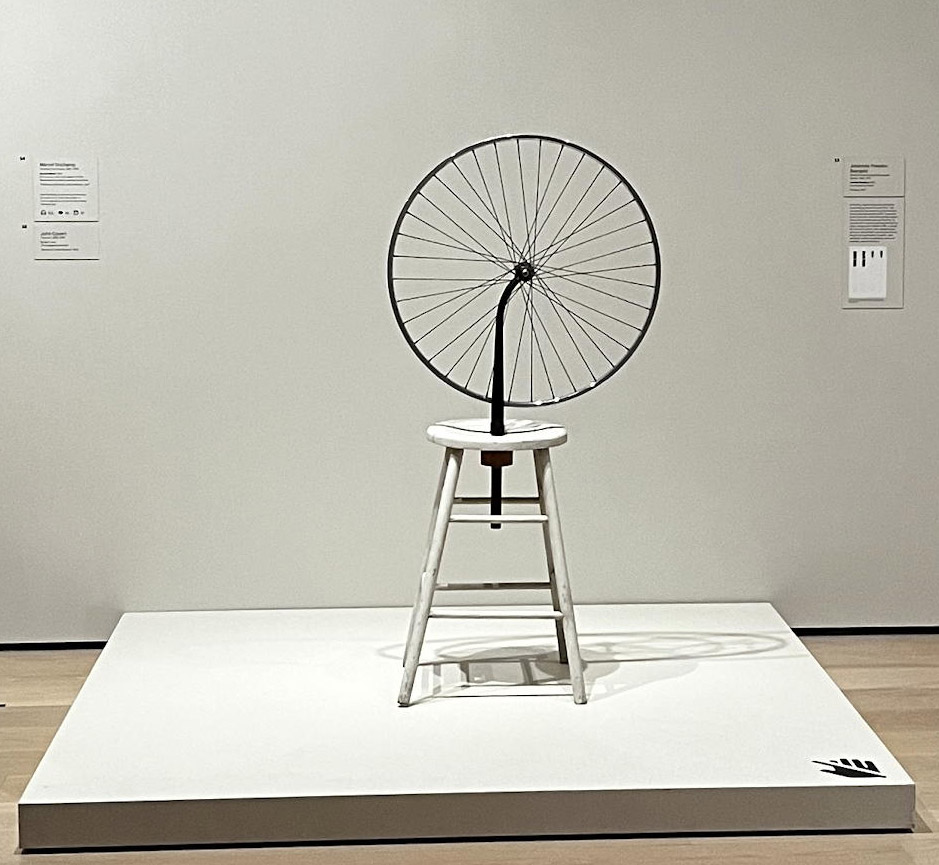
The foil letter isn’t a readymade. I didn’t pull a sheet out of the drawer and set it on a pedestal. I sat down and wrote on it for a while, which is about as un-readymade as an object can get. But the useful piece of Duchamp here is the context switch. The creative practice, Synectics, lists these types of acts under “Transfer”
- Move subject into a new situation
- Adapt, transpose, relocate, dislocate
- Adapt subject to a different frame of reference
- Move subject out of its normal environment
(by the way, there are 107 of these Synectics prompts. I compiled them all onto one page.)
The foil starts out as the stuff you wrap leftovers in. Writing a letter on it changes its function. Because it’s shiny and covered in handwriting, it picks up a third function: a mirror. Somewhere along theway, it might have become an artwork. Maybe.
The material is doing some of the thinking
Write the identical letter on printer paper, and this doesn’t do the same thing. No hand inside the surface, no face behind the words, no reflection waiting for the person on the other end. Paper looks the same no matter how you hold it, which is normally a feature.
Foil wrinkles catch light differently as it moves. It changes with every small shift in angle. The person reading it can’t settle into one stable image. Robert Morris spent a good deal of his career on that exact question in sculpture. How a viewer’s body and position and movement change the encounter with an object. Ian Burn captured this brilliantly, photographing Morris’s sculptures.
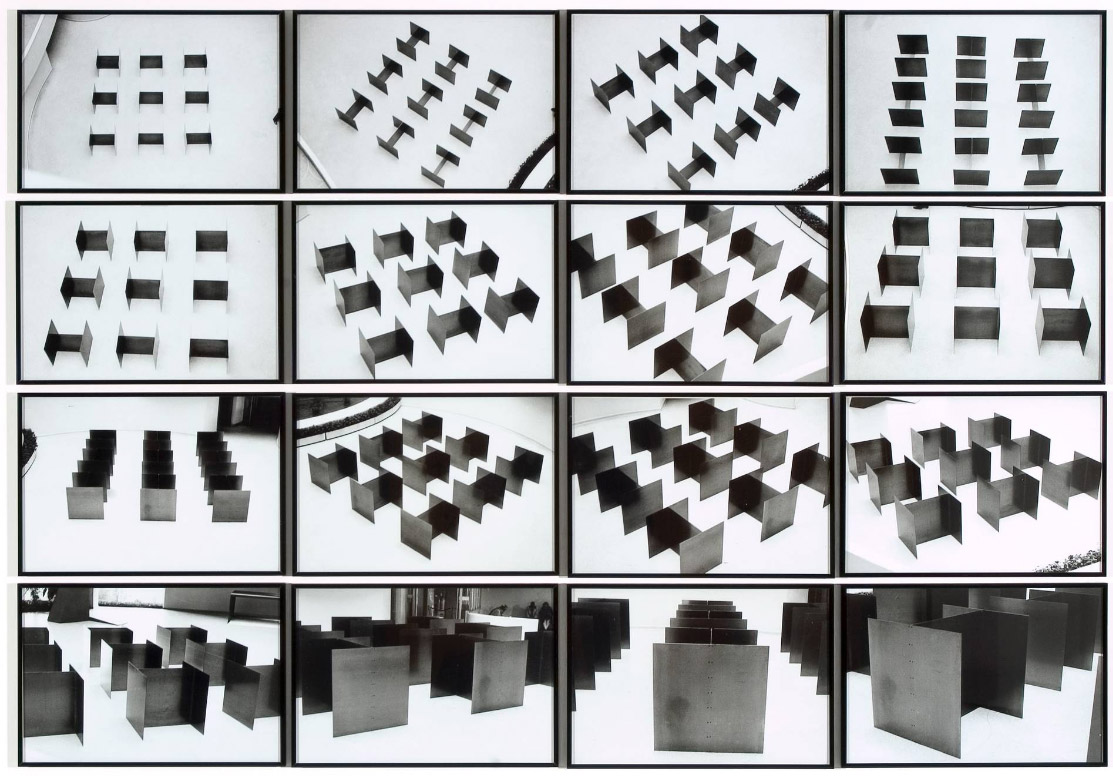
An aluminum foil letter is a much smaller (and much sillier) version of the same problem. Hold it and move it. What do you see? Move it again. Now what?
An envelope with a mirror in it
In 1964, Yoko Ono made a piece called Self Portrait that’s a small envelope (stamped with her name and the title) containing a metal mirror. That’s the whole work. You think you’re receiving an artwork. But you open the envelope, and the artwork is your own face. Hi!
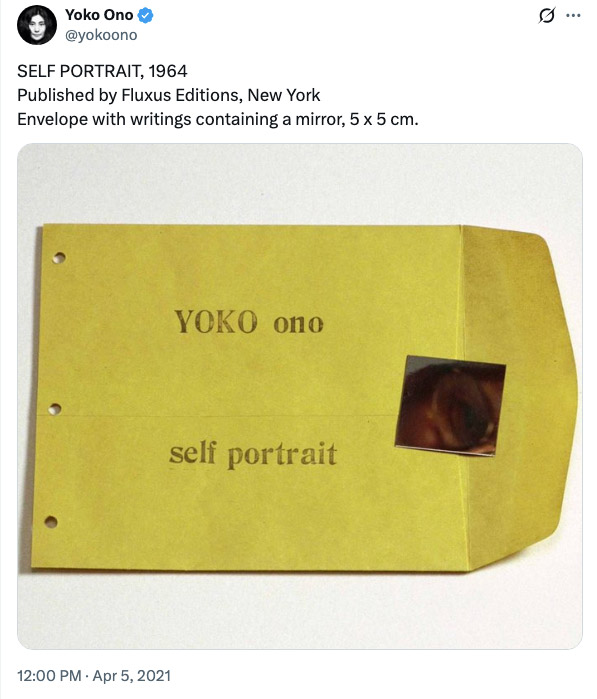
Side-point: I’m completely dumbfounded that Yoko Ono made this artwork 50+ years before I mailed aluminum foil.
And it doesn’t stop there. In another project, I put yellow ginkgo leaves into a ziploc bag, and attached the bag to the railing on an elevated train platform in 2012. The note on the bag said, “These are dream leaves. Take a leaf. Hold the leaf. Dream of something. Let the leaf fall from your hands and share your dream with the air.”
Then in 2025, I learned about Yoko Ono’s “Wish Trees.” In 1996 she attached a note to a tree saying, “Make a wish. Write it down on a piece of paper. Fold it and tie it around a branch of a Wish Tree. Ask your friends to do the same. Keep wishing. Until the branches are covered with wishes.”
I need to look into Yoko Ono’s art more. I keep mirroring her (pun intended).
Ok, back to Yoko Ono’s mirrors in the mail. I love that someone receives a mirror in the mail; the artwork is their own face.
My foil letter is a bit different from Ono’s mirrors. Ono’s mirror is the letter. Ono hands you a clean reflection with nothing written on it. Marco gets a reflection with somebody else’s sentences running across it, so he isn’t only looking at himself, he’s looking at himself while a friend talks to him.
I make the letter, he makes the reflection
Normally I’d say I’m the artist. I made this thing, and that’s mostly true. I chose the foil, chose the Sharpie, wrote the words, folded it, and addressed the envelope.
But I can’t control the light in Marco’s house, or the angle he holds it at, or how much of his face shows up behind which paragraph. So the letter is mine, but the picture is his. The finished experience is a collaboration with somebody who never agreed to collaborate.
There’s an accidental self-portrait sitting in here too. Usually a self-portrait means an artist decides to make an image of themselves, so they pose, or look in a mirror, or draw their own face on purpose. With the foil, I never draw myself at all. My hand and my face show up as a byproduct of writing sentences, and then they leave the second the letter changes hands.
Flipping around and seeing different images in a reflective surface reminds me of a book I read to my kids when they were younger. “Sorry!” by Norbert Landa, illustrated by Tim Warnes (Amazon affiliate link, borrow free on archive.org)
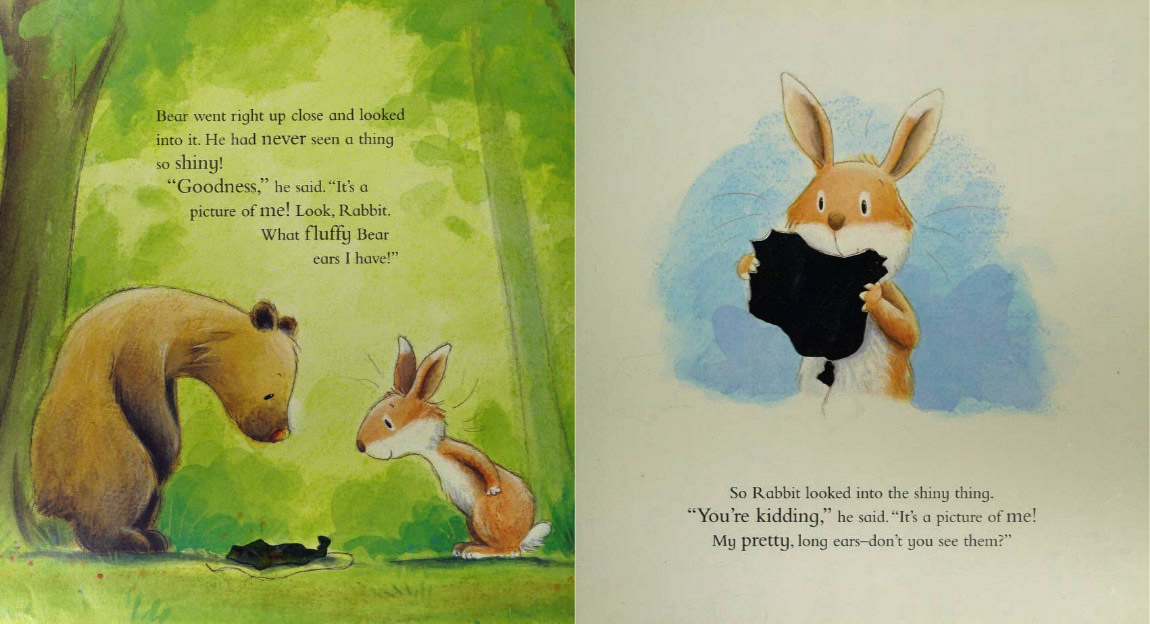
A bear and a rabbit (who are friends) find a deflated shiny foil balloon. The bear thinks his face is in the balloon. But the rabbit thinks it’s his own face. They argue, and the balloon gets torn in half. They storm off mad that their friend didn’t see each other in the balloon. Time marches on, they miss each other, and realize they want to be friends again. They reunite the two pieces of the balloon, and see the other’s face in the balloon.
The fold is not damage
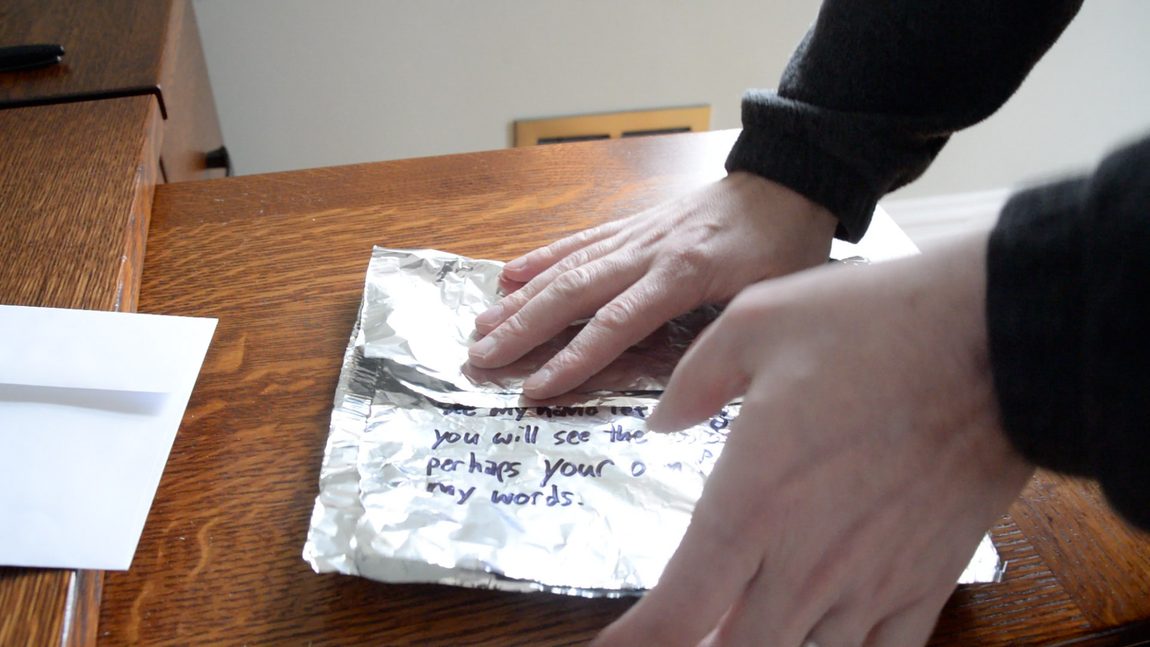
When you finish writing, you have to put a crease through the middle of the thing you just spent all that time on. It feels like vandalism for about two seconds.
But folding is what makes it a letter. The work has to become an object that can travel, so it gets folded. Without the fold, it stays in my house forever. Marco’s version now has a permanent line down the middle that I put there on purpose.
Ray Johnson already thought about this
Ray Johnson belongs at the front of any conversation about mail as an art medium. Since the 1950s he’d been sending collages and letters and odd little objects to friends and strangers through the postal system, often stamped with an instruction to add something and pass it along.
In 1962 his correspondent Ed Plunkett named the whole sprawling network the New York Correspondence School, playing off the New York School of the abstract expressionists, and Johnson switched the middle e to an a so it read Correspondance.
What to take from Johnson is that the mail isn’t just delivering the art. The mail is the art.
Ten seconds
Somebody opens the mailbox, finds an envelope, opens that, and pulls out a semi-crumpled piece of aluminum foil. What? Why did somebody mail me garbage? Then they unfold it and find handwriting, and then their own face appears behind the handwriting.
Garbage to letter to artwork to mirror, in about ten seconds. Hello, Duchamp. The object never changed. But the understanding of the object did change. Duchamp did that shift in a gallery, and I get to stage it in someone’s home.
So what is it?
Is it a letter? Yeah. Is it mail? Sure. Is it a mirror? Kinda. Is it a self-portrait? Maybe, although the recipient ends up in the portrait too. Is it mail art? You betcha. Is it just a piece of aluminum foil I wrote on because I wanted to send a friend something otherworldly? Also yes.
Join in the fun
September 1 is World Letter Writing Day. Grab the foil, write to somebody, and put a sticky note in the envelope so they know the shiny thing is the letter. I made an entire new section on spudart.org for people to participate in fun projects: spudart.org/try. In this section, you can find the details on how to participate in #lettersonfoil. I can’t wait to see what you write.
After writing all this, I just came across the fact that September 1 is also No Rhyme or Reason Day. Which is rather fitting.