

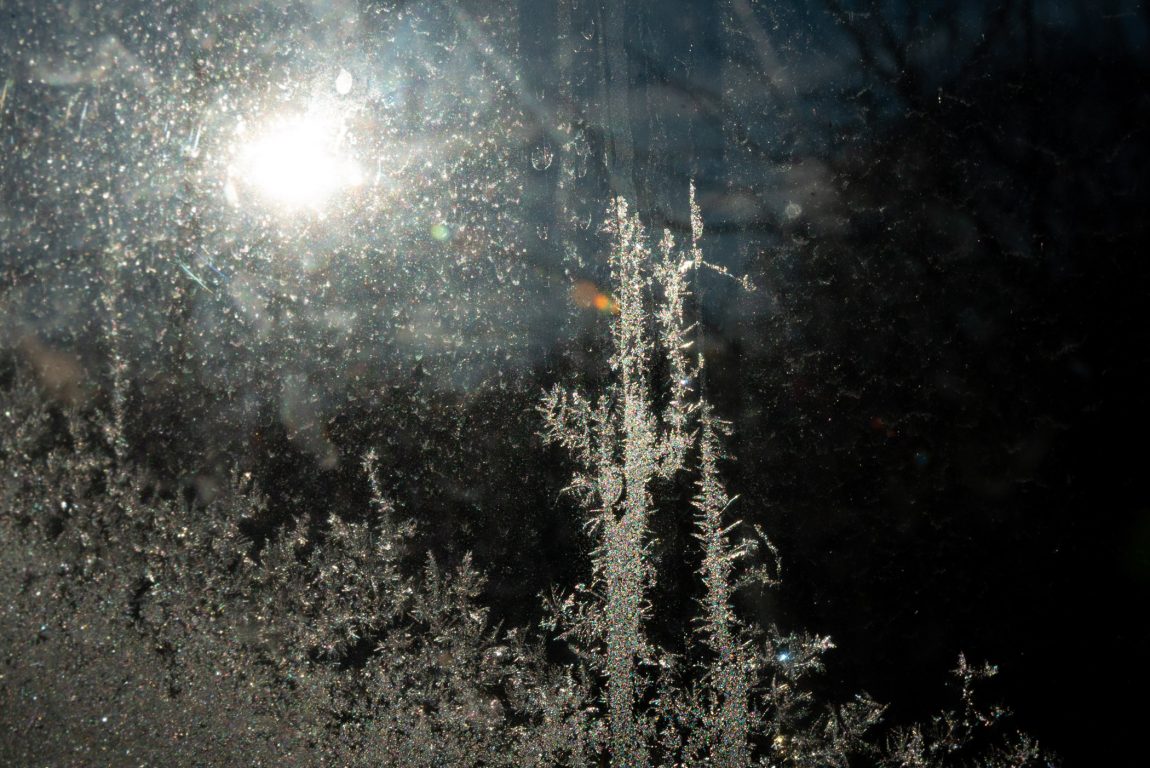
Where the sun meets the frost, the desert dreams emerge. A cactus, spun from winter’s breath, stands still against the fleeting light.
I was curious if there was any connection between cacti and frost. So I asked Chat GPT, “Scientifically speaking, is there any connection between how frost grows and how cactus grow?” The response was fantastic—especially the first point about fractals.
Scientifically speaking, frost and cacti grow in very different ways, but there are some interesting parallels when you look closely at their patterns and environmental interactions.
- Structural growth patterns:
Both frost and cacti grow in a branching, fractal-like structure. Frost forms when water vapor in the air condenses and freezes onto surfaces, growing in intricate, symmetrical patterns. Similarly, many cacti have branching patterns that look like fractals, which are forms that repeat in self-similar patterns at varying scales. This shared geometric growth in nature is a fascinating parallel, even though they arise from vastly different conditions.- Adaptation to environment:
Cacti have evolved to thrive in harsh desert conditions, with their thick, waxy skin to retain water and spiny structures to reduce moisture loss. On the other hand, frost forms under specific environmental conditions—cold temperatures, high humidity, and calm winds. While a cactus survives extreme dryness, frost requires cold moisture to form. So, both demonstrate adaptation to their environments but in opposite extremes—heat for the cactus, cold for frost.- Energy flow:
Cacti store water in their tissues, which is crucial for surviving droughts. Frost, on the other hand, forms from a release of latent heat as water vapor transitions into ice. Both processes reflect how substances move or transform in response to environmental forces—heat for cacti, cold for frost—though the mechanics are fundamentally different.So, while there’s no direct scientific link between how frost and cacti grow, both processes represent nature’s mastery of adapting to specific environmental conditions, forming patterns that are beautifully intricate, even if born from opposites.