

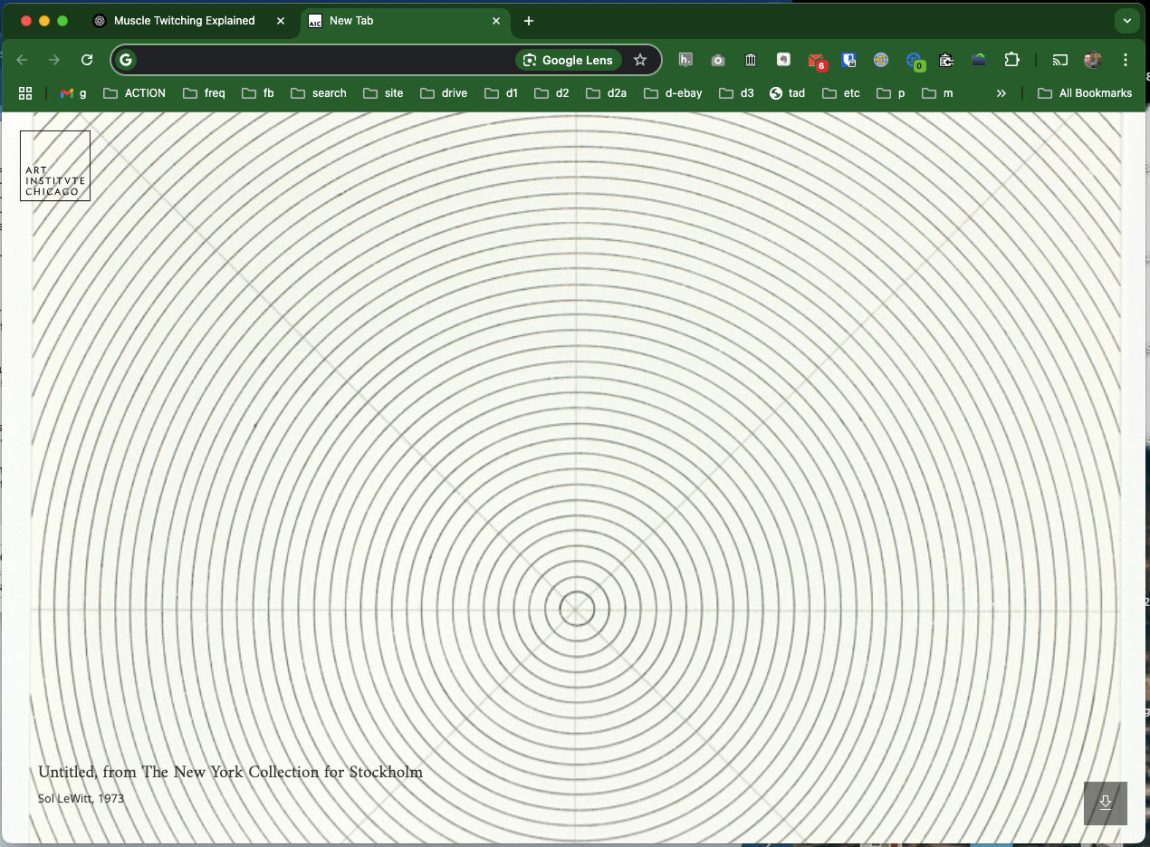
With every new Chrome tab I open, art appears.
Not just any art. A random print from the Art Institute of Chicago’s collection, served up by their Chrome extension. (I customized the extension to make the art fill the entire browser and show just prints.)
Today: Sol LeWitt’s “Untitled, from The New York Collection for Stockholm” (1973).
But wait, what am I actually looking at?
Art as Concept
LeWitt was a conceptual artist at heart. He famously stated, “The idea becomes a machine that makes the art.” His focus was on the system, the instructions, the underlying concept—not just the physical artwork itself. Many of his works, especially his wall drawings, were created by following a set of written instructions, meaning they could be recreated anywhere, by anyone, and still be considered authentic.
In a way, my Chrome tab customization aligns with his artistic philosophy. It’s a system generating a new experience each time I open a browser tab, placing his work in an unexpected context, much like how his wall drawings temporarily exist in different locations.
The chain of conceptual ownership
What I’m actually seeing is a complex chain of artistic transmission:
- LeWitt created the instructions
- Robert Rauschenberg owned these instructions
- Rauschenberg donated them to the Art Institute
- The Art Institute staff executed the instructions on a wall
- Someone photographed this execution
- The photograph was digitized
- The digital image appears in my browser
At each step, we move further from LeWitt’s original concept: that the art exists in the execution of the instructions, not in the final product.
Am I defying Sol LeWitt?
Am I engaging with LeWitt’s work the way he intended, or am I completely defying his vision?
LeWitt famously didn’t sell physical drawings. Instead, he sold instructions—sets of precise directions that could be executed by others. His art wasn’t in the final image itself, but in the process of bringing it to life. This means that the version of Untitled displayed on the Art Institute of Chicago’s website isn’t an original, in the traditional sense. It’s a snapshot of a past execution of LeWitt’s instructions, likely drawn by museum staff, installed temporarily, and eventually painted over—because that’s how his work was meant to function.
The Art Institute credits the piece as a “Gift of Robert Rauschenberg.” That’s a fascinating tidbit. Rauschenberg, an artist in his own right, didn’t just collect LeWitt’s work—he owned the instructions for how to create it. And at some point, he decided to donate those instructions to the museum. The Art Institute then followed them, realized the drawing, and now, decades later, I’m looking at a photo of that ephemeral execution on my screen.
I’m not standing in front of a LeWitt drawing that was just installed and waiting to be repainted. I’m not even interacting with his instructions. I’m looking at a frozen image—a digital echo of something that was meant to be temporary.
Would LeWitt be okay with this? Or does viewing a static photograph of a past execution strip the work of its intended ephemerality? The whole point of LeWitt’s approach was that his art wasn’t about the finished product; it was about the continuous process of re-creation. By staring at a fixed image, am I turning something meant to be repeatedly reborn into something permanently dead?
So what am I actually experiencing?
I’m experiencing a document of an execution, not the execution itself. It’s like watching a video of a dance performance rather than seeing the dance performed live.
The real LeWitt artwork would be if my browser actually generated these concentric circles following his specific instructions each time I opened a new tab. That would honor the conceptual nature of his work.
Instead, I’m looking at a frozen moment that contradicts the temporary, process-based nature of LeWitt’s art philosophy.
What would Rauschenberg think?
This question gets even more interesting when we bring Rauschenberg into the picture. He was deeply invested in experimentation, impermanence, and the interaction between art and life. He famously erased a Willem de Kooning drawing as a conceptual artwork (Erased de Kooning Drawing, 1953), emphasizing the act of destruction as a form of creation.
So why did Rauschenberg donate LeWitt’s instructions to a museum?
This wasn’t an isolated case—Rauschenberg often gifted other artists’ works to institutions. He saw museums as spaces where art could be shared, engaged with, and transformed by different audiences. He was also a champion of collaboration, frequently working alongside artists across disciplines.
By giving away a LeWitt, Rauschenberg wasn’t just being generous; he was reinforcing an artistic philosophy: Art is not just something to be owned—it’s something to be passed on, reinterpreted, and given new life.
Would LeWitt approve?
I think he might. He embraced the idea that art isn’t static—it exists in execution, transformation, and interaction. His works often played with repetition and variation, much like how my browser randomly presents different pieces. He might have even enjoyed the idea of his art being encountered digitally, breaking away from the confines of a museum wall.
The only thing he might have objected to? If the digital reproduction altered the precise structure of his composition. He was meticulous about execution, even if he didn’t always create the final piece himself. As long as the image remains faithful to the original, I’d like to think LeWitt would appreciate this unexpected extension of his art into everyday life.
This is the tension at the heart of conceptual art in the digital age. Am I passively consuming a LeWitt drawing? Or am I engaging with it in a new way—questioning its meaning, thinking about its history, and reflecting on its intent? Maybe that’s the real tribute to both LeWitt and Rauschenberg: To keep asking what art is, what it means, and how we experience it.
Either way, I’m still thinking about art before checking my email. Maybe that’s a win in itself.