

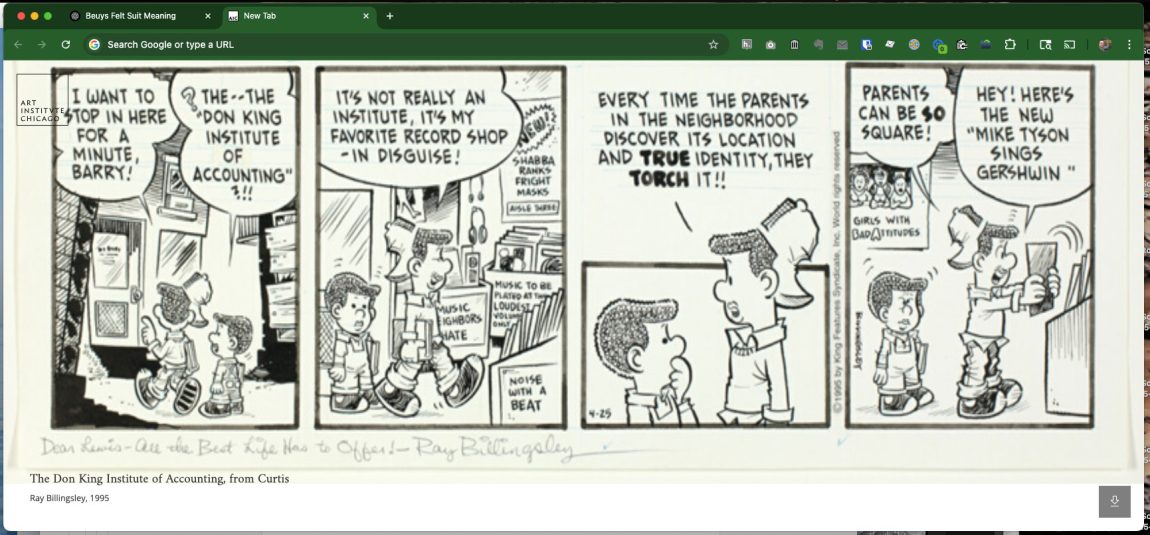
While using the Chrome plugin ArtTab, I stumbled upon an unexpected treasure: a syndicated comic strip from 1995 sitting in the collection of the Art Institute of Chicago. Ray Billingsley’s “Curtis” strip features “The Don King Institute of Accounting”—clearly a playful jab at the Art Institute’s own name.
What makes this strip particularly clever is how it subverts the very concept of an “institute.” While the Art Institute represents high-minded cultural education, Billingsley’s fictional institute is merely a front for the character’s true passion: record collecting. It’s a perfect commentary on how we sometimes dress up our obsessions in more respectable language.
Finding a newspaper comic strip in such a prestigious collection initially surprised me, but the more I think about it, the more it makes sense. The Art Institute has never shied away from collecting everyday objects—they’ve long recognized that art exists beyond oil paintings and marble sculptures. This Curtis strip represents both the democratization of art and the validation of comics as a legitimate artistic medium.
The discovery sparked a conversation when I shared it on Bluesky. The creator of the Transformers comic strip Mal & Dee responded with an intriguing suggestion: the Art Institute should host an entire exhibit dedicated to comic strip art.

Challenge accepted. I decided to reach out to the Art Institute directly to explore this possibility. Here’s the email I sent:
to: [email protected]
subject: Comic strip exhibit in the archives of Art Institute?Hi there, has the Art Institute of Chicago ever put on an exhibit of comic strip art? Or perhaps comic book art?
Preferably, it should not include the Chicago Imagists or Harry Who artists like Gladys Nilsson, Jim Nutt, etc. I’m looking to see if the Art Institute of Chicago has displayed items from more mainstream syndicated comic strips. Or mainstream comic books by the likes of Marvel, DC, Image, etc.
I ask because I recently came across a 1995 “Curtis” comic strip in the Art Institute of Chicago collection by syndicated comic strip artist Ray Billingsley. https://www.artic.edu/artworks/187979/the-don-king-institute-of-accounting-from-curtis
I was pleasantly surprised to see this artwork in the Art Institute’s collection. It made me curious about other syndicated artwork in your collection, and if there were any exhibits of this type of art. (I know this particular artwork was not in an exhibit, because the webpage for it doesn’t have an “Exhibition History” section like how other artworks on your site)
I tried a quick search through the exhibition history on your site at https://www.artic.edu/exhibitions/history. However, I couldn’t come up with any exhibits with syndicated comic strips or comic books. I’m hoping perhaps someone at the Art Institute of Chicago would know.
Thank you very much,
Matt MaldreP.S. This inquiry is for personal use. Although, I do work for Tribune Content Agency that syndicates comic strips like Dick Tracy and Annie. But this isn’t for work. I only mention my place of employment, because I’m pretty proud that I’ve been working for a comic syndicate for 25 years.
P.P.S I know down the street from the Art Institute, the Chicago Cultural Center had a show, “CHICAGO: Where Comics Came to Life (1880-1960)” on display in 2021 that featured many syndicated comic strips. It was a wonderful exhibit.
Now we wait to see if this inquiry might lead somewhere interesting. Chicago has a rich comics history—from the early days of newspaper strips to modern graphic novels—and it would be fascinating to see that legacy celebrated in one of the city’s most prestigious cultural institutions.
Who knows? Maybe that single Curtis strip is just the beginning of a larger conversation about comics as art.
Have we discussed the Cartoon Art Museum in San Francisco? Something tells me we have
Perhaps. I’ve been to the Cartoon Art Museum in San Francisco a couple times. Nice gallery space.
As time goes on, it makes me wonder about the prestige attached to an art museum’s collection, like the Art Institute of Chicago. Having an “everyday” comic strip in a prestigious collection is a little surprising.
But then I look through other parts of their collection, and it’s got like, spoons. Literally, spoons. Old spoons. Sooo. Um, yeah. What exactly makes this old spoon prestigious?
Or, for that matter, what makes a giant black painting prestigious? Its place in art history. But what determines art history? Who determines that these giant black paintings are important?
So, then we look at the collection of the Cartoon Art Museum, and that has a completely different set of criteria and history. But yet, in some ways, it’s not considered as prestigious. Why not? I bet people look at comic strips and comic books more than art. Well, actually, maybe not. Art is so pervasive. People don’t really look at comic strips anymore. Perhaps in the print newspaper era, comic strips might have competed with art in terms of eyeballs. But now, comic strips are like, what? Who looks at a comic strip?
But for that era of print newspapers, where most people saw comic strips… those comic strips are essential parts of culture. So they do have an important place.
I’m just thinking out loud, no real points here.
It’s been over four months since I emailed the Art Institute of Chicago with this question. Looks like they aren’t answering. Maybe I need to send them a reminder.
This came to my mind today, because today in my ArtTab Chrome extension appeared an artwork by Chester Gould. He’s the creator of Dick Tracy. The artwork is titled, “Sparkle Plenty Welcomes Mr. Kubicek and Mr. Gould”. https://www.artic.edu/artworks/185879/sparkle-plenty-welcomes-mr-kubicek-and-mr-gould?utm_medium=chrome-extension-spudart&utm_source=Sparkle%20Plenty%20Welcomes%20Mr.%20Kubicek%20and%20Mr.%20Gould
Sparkle Plenty is a character in the Dick Tracy comic strip. Mr. Kubicek and his wife, Patricia Ruth Cooper, were founding editors of the nation’s first television weekly magazine, TV Forecast, which later became part of the TV Guide chain.
Rather odd to see the the founding editor of a TV magazine with Chester Gould. But Chester Gould was a cartoonist for the Chicago Tribune. So I’m guessing there’s something about the TV Forecast visiting the offices of the Chicago Tribune… perhaps because the Tribune was going to include their magazine in the newspaper? (or already was running it?)