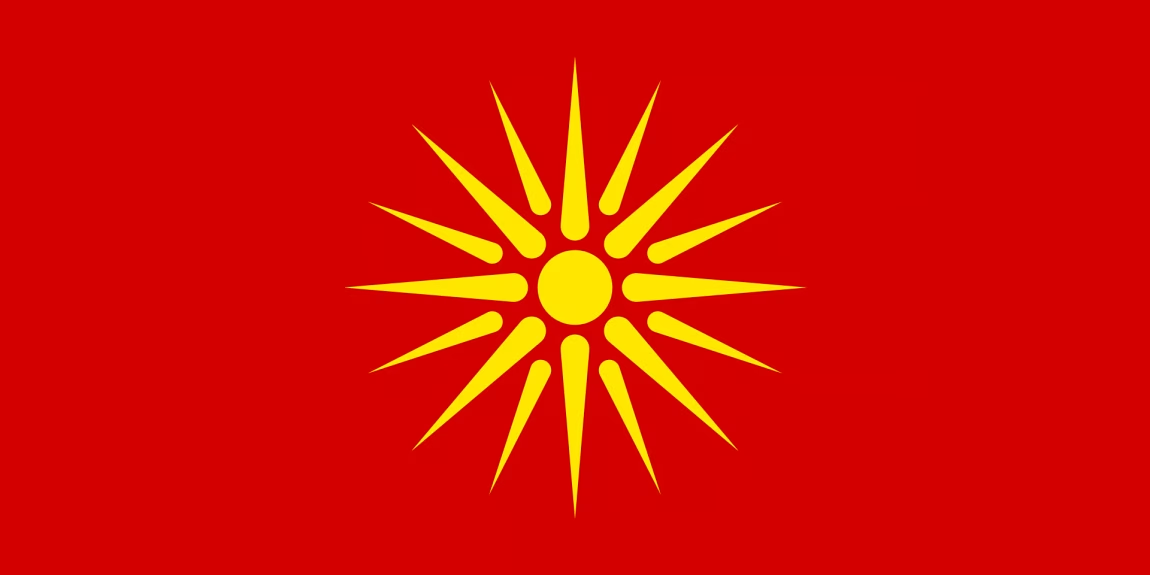
This is the flag the Republic of Macedonia used from 1992-1995
Look at that flag. The curves at the ends of the rays do a great job of implying there’s an orb at the center. It doesn’t look like a disc — it looks like a spiked ball.
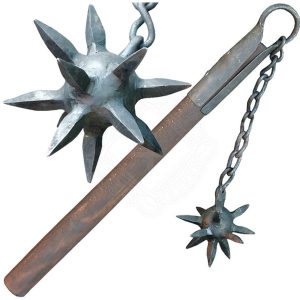
A spiked ball could communicate “we project fierce, spiked defense to anyone approaching from the outside.” But from what I understand, Macedonia gained their freedom from Yugoslavia peacefully in 1991. So a spiked ball of war isn’t really the message they were going for. Maybe a spiked ball massager would be more fitting?
(Amazon affiliate link. Amazon didn’t have any spiked balls on a chain. Go figure)
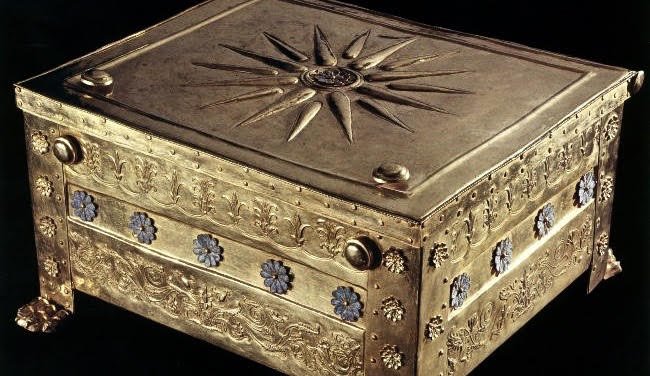
The official statement for the flag calls it a “disc”, not a sphere. And the real story behind it is way more interesting than weapon comparisons. In 1977, archaeologists dug up the tomb of King Philip II of Macedon — the father of Alexander the Great. This symbol was on his tomb.
The father of Alexander the Great! You can see why the brand new nation of Macedonia wanted to put this on their flag. It reaches back to the prestigious roots of ancient Macedonia. It says: we have history. We have roots. We are the real deal.
Archaeologists called it the Vergina Sun (named after the town Vergina, where the tomb was unearthed in Central Macedonia, Greece)
Two weeks of glory
In 1992, the Republic of Macedonia adopted the Vergina Sun for their flag. It lasted exactly two weeks before the trouble started.
July 11, 1992: The flag of Macedonia is introduced.
July 25, 1992: Due to Greek objections, the United Nations, the Olympic Games, and foreign embassies were barred from flying it.
Two weeks. The flag was two weeks old when it got banned from the Olympics.
Greece’s argument: That’s our symbol. It belongs to our northern province, which is also named Macedonia. The Greek government feared that a new, sovereign Slavic nation calling itself “Macedonia” and flying Alexander the Great’s royal family crest implied a territorial claim on Greece’s own northern lands.
Talk about conflict! Over graphic design! I love it!
The more technical reason for the Olympic ban was that Macedonia’s National Olympic Committee hadn’t yet been formally recognized by the International Olympic Committee. But the outcome was the same: those poor athletes from Macedonia. They had just gotten their independence, and now they couldn’t compete under their own flag. Six Macedonian athletes competed as Independent Olympic Participants (IOP) in the Barcelona 1992 Summer Olympic Games.
The six who competed anyway
Elizabeta Pavlovska Women’s 100 metres hurdles — Qualifying Heat: 14.26 (did not advance)
Lazar Popovski(competed in 1992, 1996, 2000, and 2004; flag bearer in 2000) Canoeing: Men’s Kayak Singles, Slalom — 123.82 (34th place)
Kire Filipovski(also competed in 1996) Swimming: Men’s 200 metre butterfly — Qualifying Heat: 2:08.71 (did not advance)
Nataša Meškovska Swimming: Women’s 100 metre butterfly — Qualifying Heat: 1:04.16 (did not advance) Swimming: Women’s 200 metre butterfly — Qualifying Heat: 2:16.54 (did not advance)
Zoran Šorov(also competed in 1984 and 1988) Wrestling: Men’s freestyle 57 kg
They competed without their flag, without their name fully recognized, as “Independent Olympic Participants” — a bureaucratic placeholder for a country that very much existed.
What is your country’s name, exactly?
The 1992 Olympics passed. In 1993, more bad news arrived. The United Nations declared the country would henceforth be called “the former Yugoslav Republic of Macedonia”. That’s the name of their country. A six-word name. The UN explicitly stated that “the expression begins with the uncapitalized words ‘the former Yugoslav’, acting as a descriptive term, rather than ‘The Former Yugoslav’, which would act as a proper noun.”
So it’s lowercase the. This matters, apparently.
But it raised a whole new problem: where does a country called “the former Yugoslav Republic of Macedonia” sit alphabetically? Wikipedia’s entry on the Macedonia naming dispute explains what happened:
Greece rejected seating the Republic’s representative under M [as in “Macedonia (former Yugoslav Republic of)”], and the Republic rejected sitting under F (as in “Former Yugoslav Republic of Macedonia,” which turned the reference into a proper noun rather than a description). Instead, it was seated under T as “the former Yugoslav Republic of Macedonia” and placed next to Thailand.
Seated under T. Next to Thailand. Because of a lowercase t in “the.”
The grievances kept stacking up. In 1994, Greece blocked Macedonia’s access to its closest seaport — an economic blockade that cost Macedonia 2 billion dollars.
In 1995, Macedonia capitulated. The Vergina Sun came off the flag.
Before we get into the new flag, let me point out that I came across this flag and its story on Phil Huckleberry’s newsletter, Meta-Spiel. He has an interesting perspective on the flag. Check out his post, Phthursday Musings: School’s Out.
The new flag (sort of)
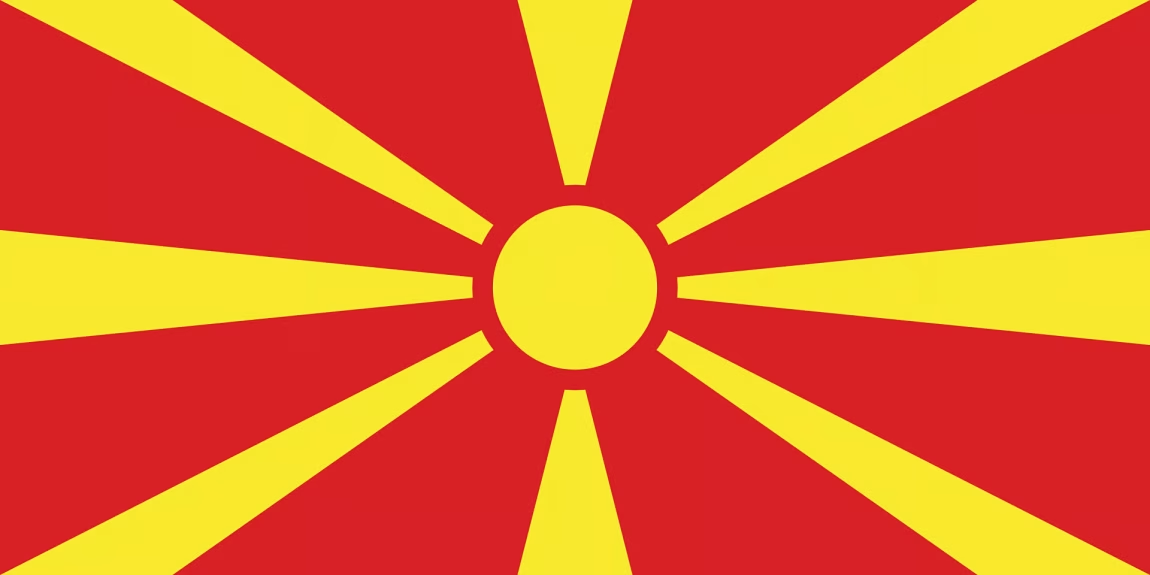
It looks like they took the Vergina Sun’s rays and expanded them all the way to the borders of the flag. Which seems odd — Greece was so upset about the symbol, and yet here it still is, kind of. The sun is still there. The rays still burst outward.
There are some differences, though. Notice how the ends of the rays no longer curve. They end in a straight line just before meeting the sun disc. No more implied sphere. No more spiked ball. Just clean geometric rays that clearly read as flat — a disc, not an orb.
It’s a subtle distinction that apparently mattered enough to avoid another international incident.
The cartoonist who designed a country’s flag
The designer of the 1995 flag is a Macedonian named Miroslav Grčev. One year after designing the flag, he became mayor of the largest city in “the former Yugoslav Republic of Macedonia.” A person who designs the country’s flag then becomes mayor of its biggest city. Has that ever happened anywhere else?
Grčev is, according to Wikipedia, a Macedonian architect, graphic designer, comic artist, and caricaturist.
Comic artist‽ The flag of a country was designed by a comic artist?
Are any of his comics online? Sadly, no. But there is a book, “Seven Decades of Macedonian Comics,” that mentions him. Here’s what Google Translate pulled out:
Grčev published his first comic in March 1971 in the newspaper Fokus.
His most famous creation was the weekly strip “Studentskiot Trajče,” which ran in Studentski zbor.
He was also a director of short animated films, part of what was known as the “Macedonian school of cartoons.”
He stopped creating comics in 1981, citing a lack of publishing space, the “immaturity” of the local environment in accepting the medium, and the incomprehensibly low valuation of comic creation at the time.
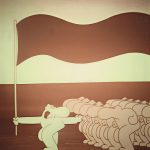
Back in 1980, Grčev directed a two-minute animated film called Black Flag. I cannot find a watchable version anywhere online, but the description goes like this:
A man with a black flag in his hands leads a large group of people. The masses obey the leader’s commands despite the fact that he is leading them into an abyss. However, the flag he carries is tied to a tree and from the collapsing table only the leader is saved, climbing the flag.
He made an animated film about a flag leading people into an abyss. Fifteen years later, he was designing his country’s flag.
How does a comic artist end up designing a national symbol? It actually makes a lot of sense when you look at his background. He had extensive graphic design experience. He was an architect accustomed to thinking about public space and identity. Starting in 1992, he worked on the Detailed Urban Plan for Skopje — a district-level master plan dictating building heights, land use, and construction conditions for individual plots. He was someone who thought professionally about how societies represent themselves in space. When the government needed someone to design a new national symbol during a political crisis, they found their person.
The new flag must use the same colors as previous national flags — a blood-red base with a golden-yellow symbol.
The flag must include a graphic symbol of the sun.
So he had to use the sun. He made a bunch of versions. Then the design that was selected got quietly altered without him. He has not gotten over it:
Moreover, someone, evidently at the last moment, had separated the rays from the sun’s disc, and left them cut away, spreading as planks. It was clear to me that the adopted design was a “victim” of an overnight “political debate” in which the “compromise” was an evident and ignorant uglification of the graphical solution, realised that night “on the fly”.
And:
Ever since that October I am carefully following the situation, and I’m waiting for the moment when there will be born a consciousness of the need of a technical, practically aesthetic, correction of the national flag, and it’s artistic harmonization. I am waiting for that moment persistently and unhesitantingly, even though I note that an aesthetic correction, as a curse or faith’s spite, has as little chance to gain political support, as much as, from an expert’s point of view, it is more logical and necessary.
He really doesn’t like that the rays don’t touch the sun. And honestly? I kinda agree with him. That red circle around the sun is a little distracting. The rays feel disconnected — like they’re floating nearby rather than radiating outward. His original vision must have felt more alive.
Today Grčev is admired by some as an independent thinker who challenges nationalist myths and defends modern urban planning. Others strongly disagree with his views on Macedonian history and identity. It’s curious that he was the one chosen to redesign the flag when he seems to have complicated feelings about Macedonian national symbolism — or maybe I’m misreading his position.
N-Mac
From 1993 to 2019, the country was officially known as “the former Yugoslav Republic of Macedonia” — a six-word name they carried for 26 years. They competed under that name in every Summer and Winter Olympics from 1996 through 2019.
In 2019, Greece and Macedonia agreed to alter the constitutional name. The International Olympic Committee formally approved the switch to North Macedonia. The first Olympic Games under that name was the 2020 Tokyo Games.
North Macedonia is a country. Now you know.
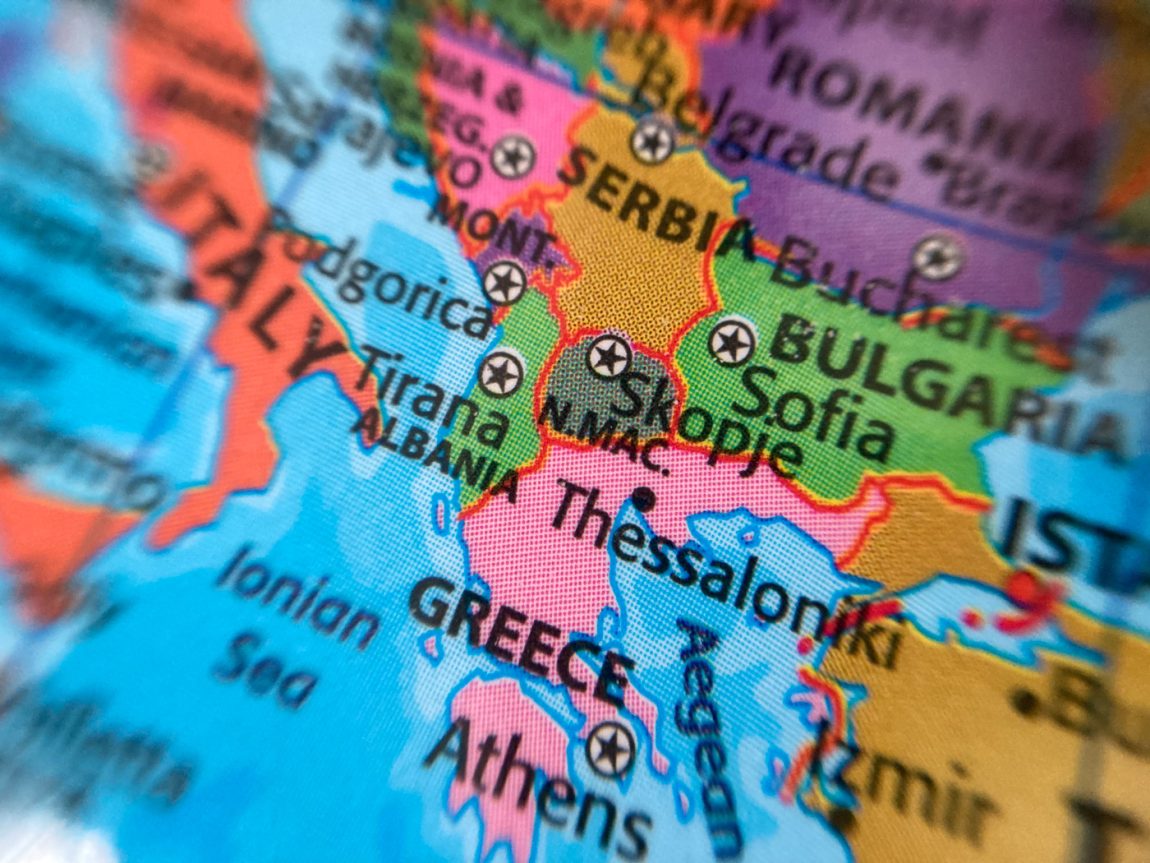
I thought our globe at home wouldn’t have North Macedonia on it at all — and I was especially curious how it would fit the full old name. But our globe is a newer edition. It’s got the country listed.
Abbreviated as N. Mac.
N-Mac. That’s a great name. After all that drama — the Greek objections, the 2-billion-dollar blockade, the six-word country name seated under T next to Thailand — maybe they should have just gone with N-Mac from the start.
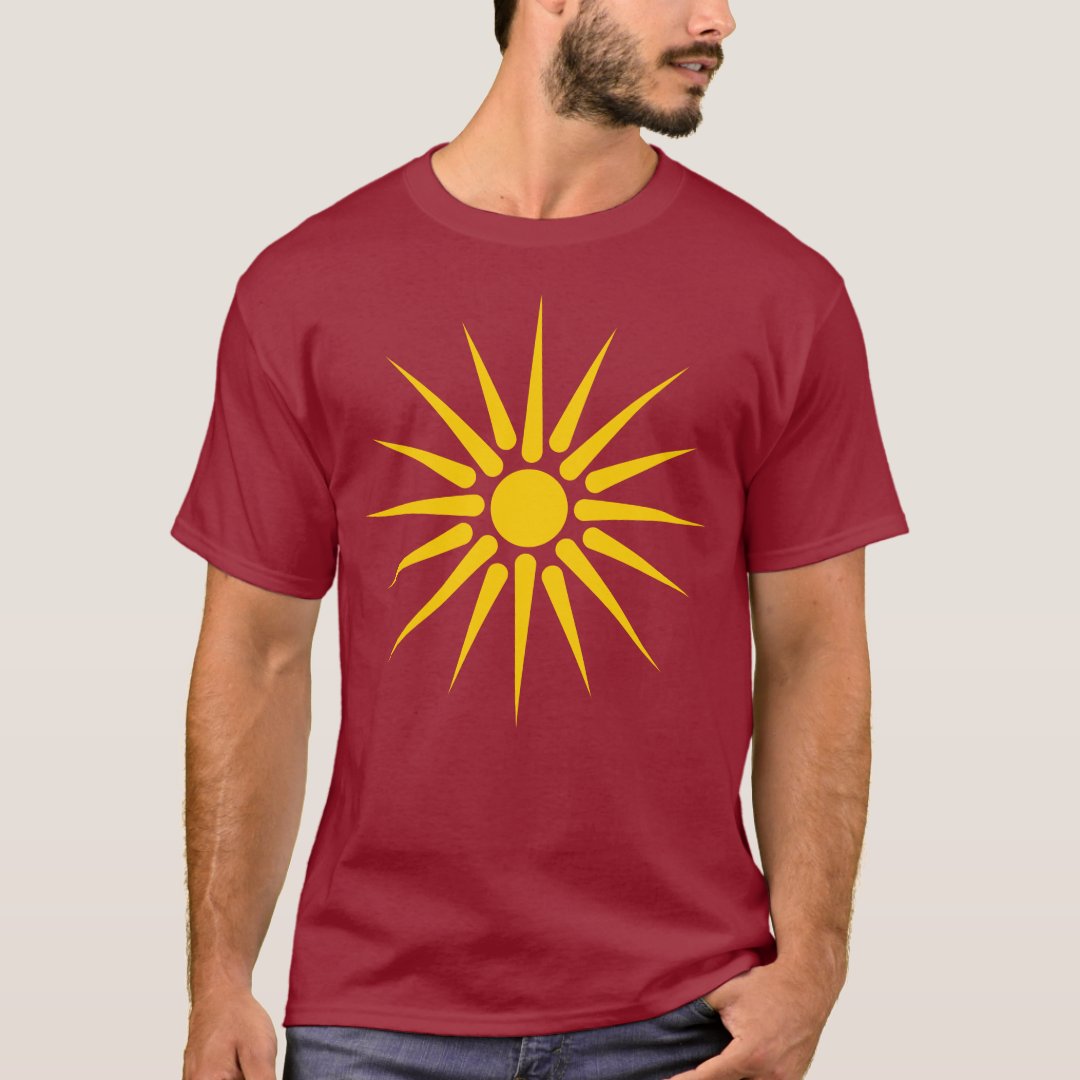
The N-MAC t-shirt with Vergina Sun
Since there aren’t any N-MAC tshirts, I made one. You can buy it.
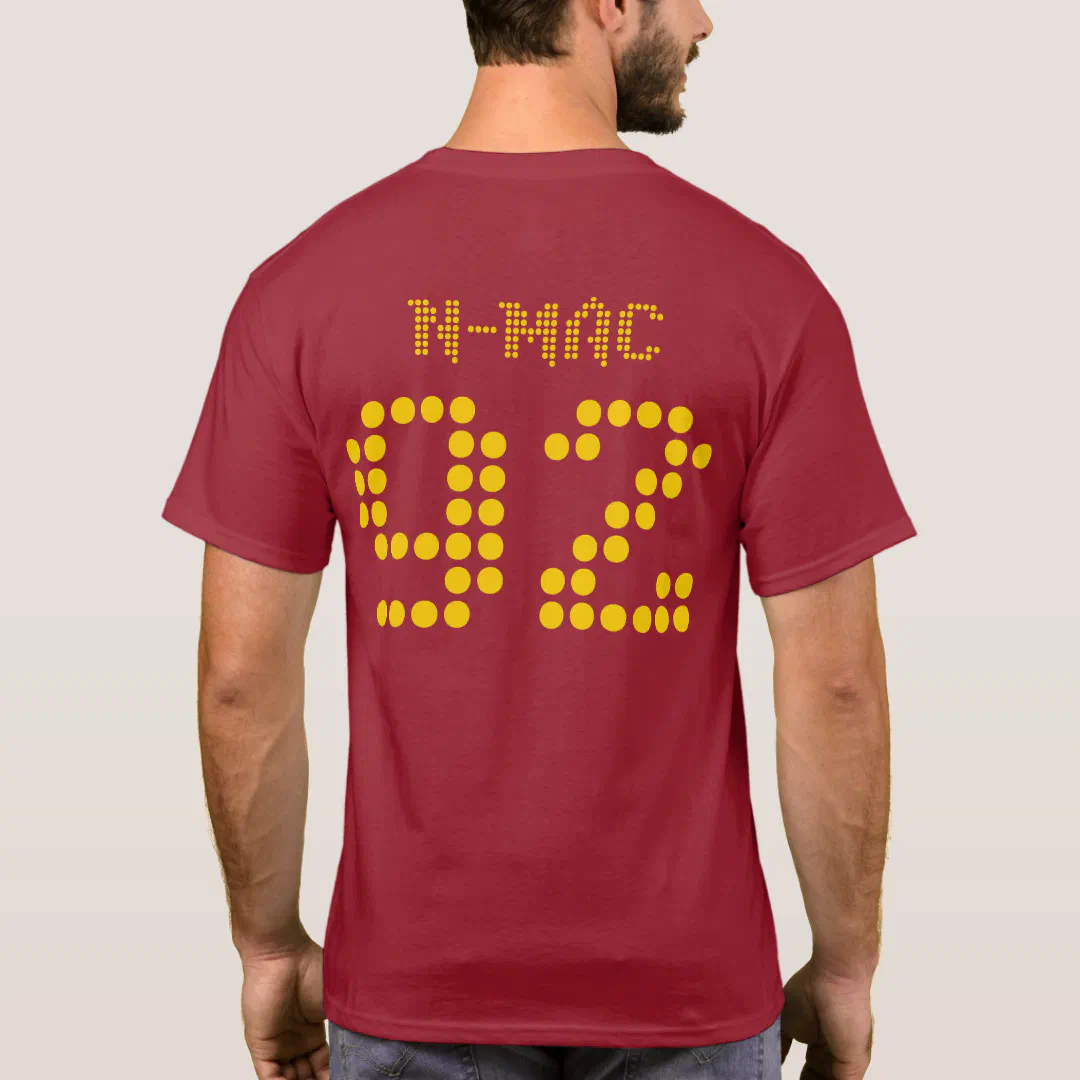
As if the front wasn’t cool enough, check out the back
That’s right, it’s got “N-MAC” on the back. The font uses round dots, mimicking the nice round edges to the rays on the Vegina Star. A nice big 92 points to the year when Macedonia couldn’t fly their new flag at the Summer Olympics. Now you can fly the Macedonia Vergina Star with this shirt. Get yours today!
These are side-points that aren’t really related to the post. But they were too much to not include.
Does anyone else call North Macedonia “N-Mac”? Googling “N-Mac” tshirt returns no results. Although there is this, uh, interesting shirt with “Still MAC’N“:
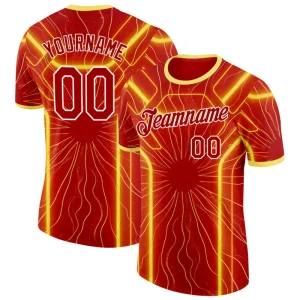
You can see the sunburst in the jersey design. It also looks kind of like Tron. The bad guys in Tron’s colors were red and yellow. I’d get this jersey with “TESLER” on the back — General Tesler would most likely wear number 5 on the soccer field, representing the traditional number for a sweeper or central defender. As CLU’s cold, commanding henchman, he controls the backline and shuts down threats, acting as a defensive wall much like the character himself. Team name on the jersey: Argon City, the setting for Tron: Uprising.





According to my Thea Vula… we’re all Turks