

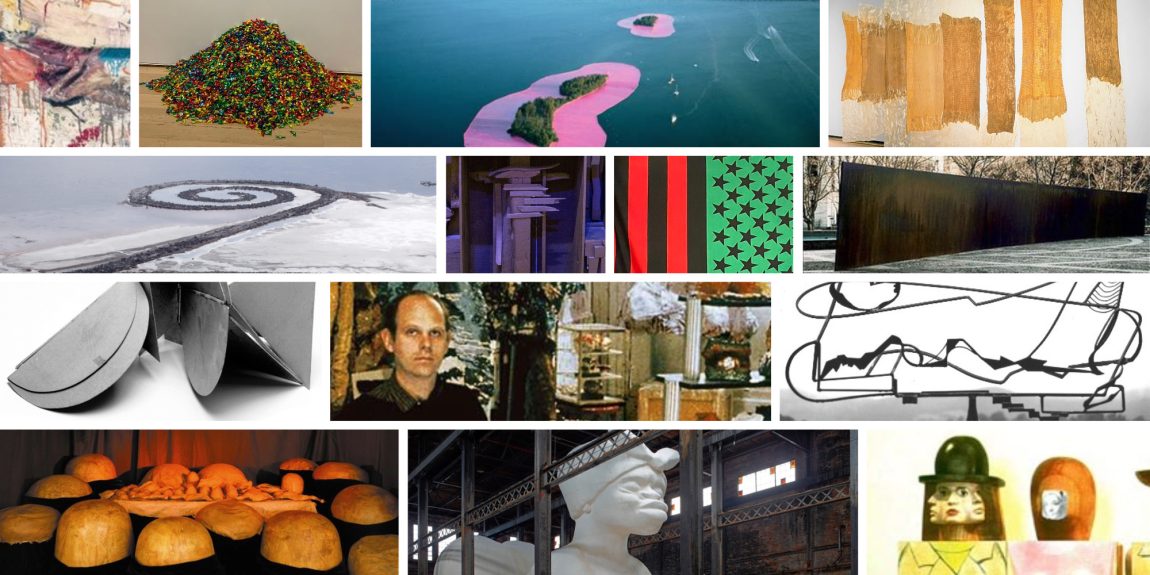
The New York Times published its 25 most important sculptures since 1945 (paywall-free article). It’s absolutely fascinating hearing the panel of five experts dialogue back and forth. They argue about a sphinx made of sugar. One says it’s simplistic, another says it’s radical. They fight about Maya Lin’s Vietnam Veterans Memorial.
The punch ’em out debate resulted in this list:
- David Smith, “Hudson River Landscape,” 1951
- Lygia Clark, “Bichos,” 1959-66
- Kara Walker, “A Subtlety,” 2014
- Claes Oldenburg, “The Store,” 1961
- Melvin Edwards, “Lynch Fragments,” 1963-2026
- Marisol, “Women and Dog,” 1963-64
- Noah Purifoy, “66 Signs of Neon,” 1966
- Robert Rauschenberg, “Bed,” 1955
- Richard Serra, “Tilted Arc,” 1981
- “Benefit for the Student Mobilization Committee to End the War in Vietnam” at Paula Cooper Gallery, New York, 1968
- Robert Smithson, “Spiral Jetty,” 1970
- Eva Hesse, “Contingent,” 1969
- Gordon Matta-Clark, “Splitting,” 1974
- Louise Bourgeois, “The Destruction of the Father,” 1974
- Christo and Jeanne-Claude, “Surrounded Islands, Biscayne Bay, Greater Miami, Florida“, 1980-83
- David Hammons, “African-American Flag,” 1990
- Rirkrit Tiravanija, “Untitled 1990 (Pad Thai)”
- Felix Gonzalez-Torres, “‘Untitled’ (Portrait of Ross in L.A.),” 1991
- Martin Puryear, “Liberty/Libertà” at the Venice Biennale, 2019
- Pope.L, “The Great White Way: 22 miles, 9 Years, 1 Street,” 2001-09
- Lauren Halsey, “The Eastside of South Central Los Angeles Hieroglyph Prototype Architecture (I),” 2023
- Louise Nevelson, “Sky Cathedral,” 1958
- Isamu Noguchi, “Sunken Garden for Chase Manhattan Bank Plaza,” 1961-64
- Isa Genzken, “Fuck the Bauhaus: New Buildings for New York,” 2000
- Alexander Calder, “Black Widow,” 1948
(This list is not ranked. Imagine the bloodshed if they tried ranking the artwork.)
How did they spread their selections across time? Did they favor any decade?
| Decade | Count | Artists |
|---|---|---|
| 1940s | 1 | Alexander Calder |
| 1950s | 3 | David Smith, Robert Rauschenberg, Louise Nevelson |
| 1960s | 8 | Lygia Clark, Claes Oldenburg, Isamu Noguchi, Melvin Edwards, Marisol, Noah Purifoy, Eva Hesse, Paula Cooper Gallery benefit show |
| 1970s | 3 | Robert Smithson, Gordon Matta-Clark, Louise Bourgeois |
| 1980s | 2 | Richard Serra, Christo and Jeanne-Claude |
| 1990s | 3 | David Hammons, Rirkrit Tiravanija, Felix Gonzalez-Torres |
| 2000s | 2 | Isa Genzken, Pope.L |
| 2010s | 2 | Kara Walker, Martin Puryear |
| 2020s | 1 | Lauren Halsey |
Over the span of 81 years…
- 11 of the 25 works are between 1961 and 1974.
- A 14-year window holds 44% of the list.
Two dead zones: nothing between 1984–1989, and nothing between 1992–1999. The three 1990s entries all cluster in 1990–91. Then the list jumps to 2000.
Despite these dead zones, there are aspects of this list that I find myself being influenced by. Sure, there are some artists I’ve never heard of. But they are part of a larger movement and themes that have been prominent over the past 80 years.
Temporary artwork
And at least nine of these 25 are sculptures you can no longer go stand in front of. Serra’s “Tilted Arc” was cut into pieces and hauled to a government parking lot in Brooklyn. Kara Walker’s sugar sphinx is down to one hand. Matta-Clark’s split house lasted three months. Christo and Jeanne-Claude recycled the pink fabric. Pope.L’s 22-mile crawl is now a video. Noah Purifoy’s “66 Signs of Neon” went on tour and a lot of it didn’t come back. Oldenburg’s “The Store” was a storefront that closed, and the Paula Cooper benefit was a show that ended. Halsey’s Met rooftop came down too.
The temporary nature of these artworks makes me realize how much these themes have impacted my art. I drop stuff in public, leave it, and it disappears. Perhaps picked up by a stranger. More likely stepped on, and then landing in the curb.
Requiring a stranger’s hands to exist
Four of the 25 don’t work at all unless a stranger does something. Lygia Clark’s “Bichos” are hinged aluminum panels that stay inert until you pick one up and bend it. My favorite, Felix Gonzalez-Torres, put 175 pounds of candy on a gallery floor and let you take a piece. Rirkrit Tiravanija cooked pad thai in a wok and served it to whoever showed up. And the Paula Cooper benefit included Sol LeWitt’s first wall drawing, which is a set of instructions for somebody else’s hand.
My 900-piece series, “What is your treasure,” works the same way. You find a tiny tooth treasure chest on the sidewalk. You pick it up. You open the lid. Inside is a folded scrap of paper: “What is your treasure?”
I’ve left 900 of them out there. I don’t know where a single one is now.