

Update after publishing the original post
What I wrote in this blog post is completely wrong. Oh man. I’m keeping it up, because, well, I don’t know why. In the comments, Phil pointed out some important points about Piet Mondrian. I looked up a bit about his theories and how he lived his lifestyle according to his theories. Let me say, he definitely did not paint landscapes and his abstracts at the same time.
If anything, the following blog post is now more like a sort of imagination satire. Something that Mondrian would never do.
The original post
When you think of Piet Mondrian, you picture the grids. The primary colors. The black lines. That’s the Mondrian brand, right?
So it’s startling to encounter this:
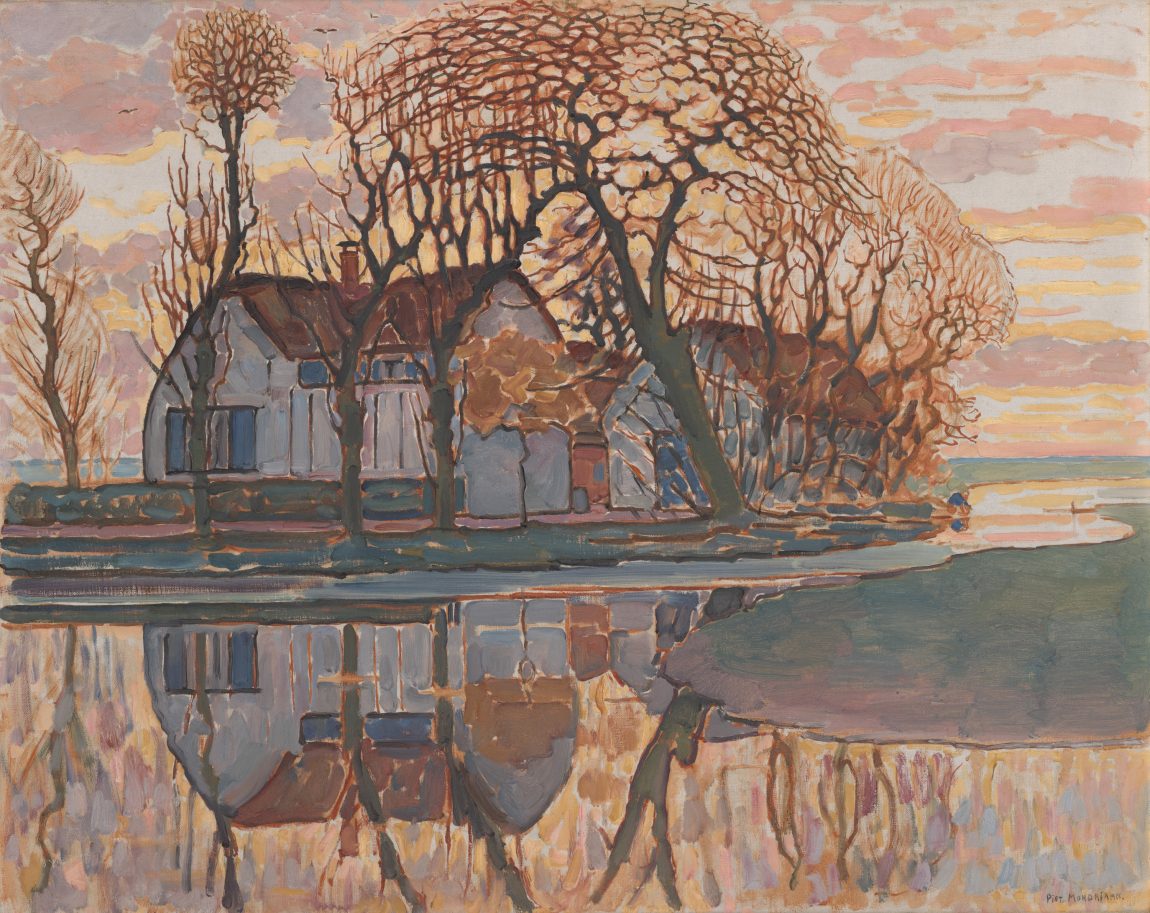
A pastoral landscape. Soft colors. Recognizable buildings and trees. You can see hints of what’s coming—the way he’s organized the composition into horizontal and vertical zones, the flattening of space into geometric chunks. And especially the abstract pattern in the trees. But this is still clearly a farm.
Here’s what makes this fascinating: Mondrian painted this around the same time he was creating works like this:

Both paintings are in the Art Institute’s collection. The abstract piece is almost always on display. The landscape appears only occasionally, in special exhibitions.
Working in two languages at once
The estimated date range for the farm painting (1911-1921) overlaps completely with Mondrian’s most radical abstractions. The end of that range—1921—is the exact year he painted the Lozenge Composition.
This isn’t a story of transformation. It’s not “Mondrian evolved from landscapes to abstraction.” He was doing both. Simultaneously.
While developing the visual language that would make him famous, he was still painting farms. He didn’t wait until he’d “perfected” his abstract style. He didn’t worry about confusing his audience or diluting his brand. He explored multiple modes at once.
A lesson for artists
We often think artists need to find their style and stick with it. Build a recognizable body of work. Be consistent. Develop a signature that collectors and galleries can identify instantly.
But Mondrian in 1916 wasn’t concerned with any of that. He was following his curiosity in multiple directions. The landscape work and the abstract work probably informed each other—different ways of thinking about space, color, structure, truth.
What if more artists gave themselves that freedom? What if you didn’t have to choose?
They could hang together
I wish the Art Institute would display these two paintings side by side permanently. Not just because it would illuminate Mondrian’s process, but because it would show museum visitors something important: artistic practice doesn’t have to be linear. You don’t have to corner yourself.
The rigid categories we create—”the landscape period,” “the abstract period”—often flatten the messier, more interesting reality of how artists actually work.
Mondrian held two visual languages in his mind at once. Maybe that’s not a footnote to his career. Maybe that’s the whole point.
Ooops
Mondrian definitely did NOT paint these two paintings at the same time. Check out the comments for how I learned about this.
I read Mondrian’s book / treatise a couple of years ago. I suspect that the farm work is a transition piece. The name suggests he was in Holland at the time so that makes it more likely the work began before 1918. At some point he went very deep into the abstract world though. After 1921 everything is kind of similar even when it’s not.
It doesn’t detract from the argument but I think it does contextualize it and often transitional art is more interesting than what comes before or after, or maybe it informs what comes after. If he went fully abstract, you can see in the farm painting what he was abstracting… sort of.
Mondrian by some point was truly nuts, I’m convinced. His treatise is some really wild stuff.
That’s a good point about the landscape being started earlier. It’s dated “1911-1921”. I don’t know how I overlooked that. In retrospect, I just took the end date and ran with it.
Well, yeah, then the landscape is more about being a transition piece, which is still interesting.
I must have completely forgotten about Mondrian’s turn to abstractness and how he lived that in his life. Mondrian didn’t just paint grids; he lived them.
Looking back at some examples: He reportedly sat with his back to windows in restaurants so he wouldn’t have to look at trees or grass. When his colleague Theo van Doesburg started using diagonals in his own work, Mondrian was so offended by the “betrayal” of the vertical/horizontal harmony that he quit the De Stijl movement and stopped speaking to him.
Like, what‽
His studios in Paris and New York were essentially walk-in versions of his paintings. He painted the walls white and tacked up movable colored cardboard rectangles. Everything had a precise, mathematical place. If a guest moved a chair slightly, it could ruin his entire sense of “equilibrium.”
Momma mia. This is certainly NOT a guy who painted both landscapes and his grids at the same time.
Wow, I couldn’t be any more wrong.