

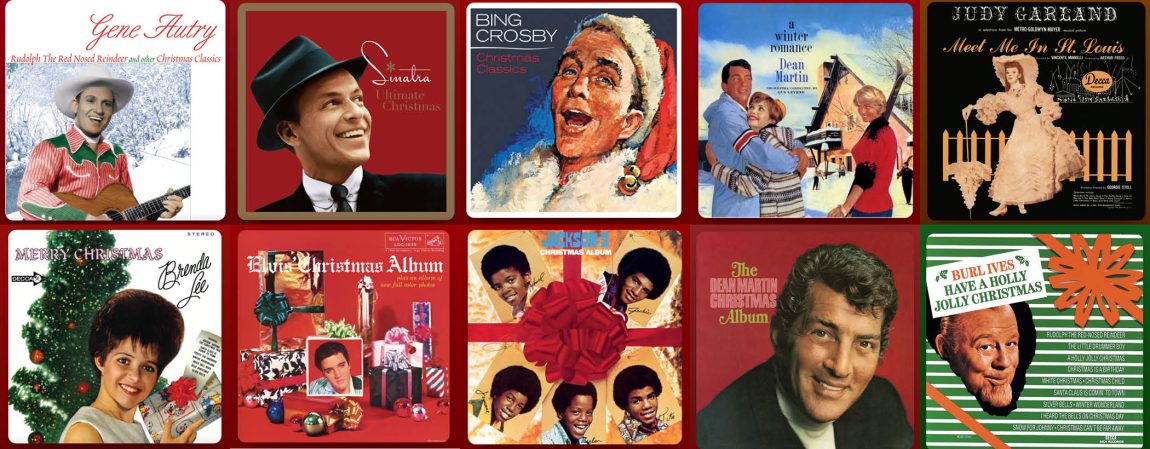
Why does every grocery store in America play the same dozen songs from 1950?
It’s December, which means you’re hearing “White Christmas” roughly 847 times before New Year’s. Along with “Jingle Bell Rock,” “Rudolph,” “Silver Bells,” and the rest of the usual suspects—nearly all of them recorded before you were born, possibly before your parents were born.
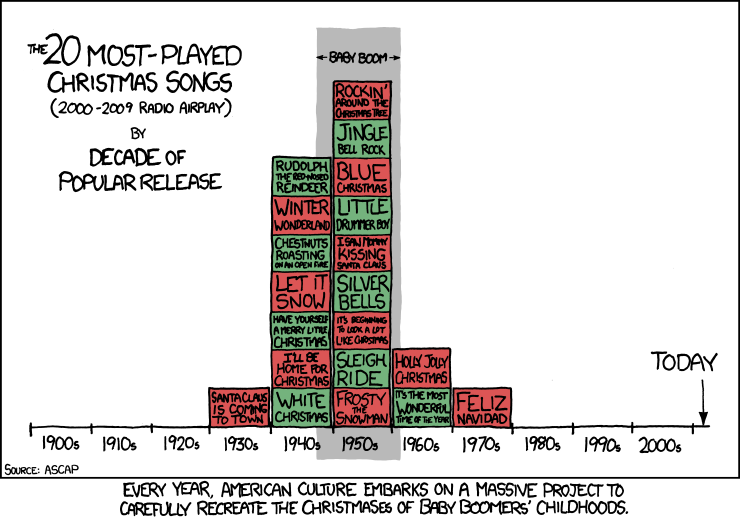
There’s an xkcd comic that visualizes this perfectly: a bar chart of the most-played Christmas songs shows the 1940s and 1950s towering like skyscrapers while the 1990s and 2000s lie completely flat. The caption: “Every year, American culture embarks on a massive project to carefully recreate the Christmases of Baby Boomers’ childhoods.”
It’s a perfect joke, but I don’t think nostalgia fully explains it. Something deeper happened during those mid-century decades that locked in our Christmas soundtrack forever. And understanding what changed can explain why, despite thousands of new holiday songs released every year, almost nothing new manages to break through.
Modern Christmas songs try very hard to join this group, but they rarely succeed, no matter how many playlists they inhabit or how much they circulate on social media.
Recently I started thinking about a theory that explains it in a way that feels surprisingly satisfying. The short version is that there used to be a stigma around releasing Christmas music, and that stigma helped shape the canon. Today the stigma is gone, and the flood of new holiday music actually prevents anything new from becoming a classic.
The old stigma: when Christmas albums were not “serious art”
For a long time, Christmas albums were considered unserious. From the 1950s through the 1980s, recording a Christmas album was something of a career hazard if you were not already established as a crooner or mainstream vocalist. If you were a rock musician or an artist who wanted to be taken seriously, a Christmas album suggested you were pausing your real work. It felt like commercial filler rather than artistic expression. The only artists who comfortably entered the Christmas space were the ones who already lived in that aesthetic. People expected Perry Como or Andy Williams to release Christmas records. Nobody expected David Bowie or Blondie to do it. The holiday album was almost a genre unto itself, and artists treated it with caution.
Because of this stigma, far fewer artists recorded Christmas music. That scarcity had a side effect. The songs that did exist received an enormous amount of repetition. If a radio station wanted festive music, there were only so many options, so the same songs cycled year after year. Over time those songs crystallized into the canon. Bing Crosby did not have to compete with thousands of other new Christmas recordings. He had the field nearly to himself. Nat King Cole’s “The Christmas Song” rose to the top partly because there were not fifty new contenders released every year. Cultural memory formed around these songs because they were the only ones available.
The 1990s: The stigma starts to crumble
Then the 1990s arrived, and something shifted. Mariah Carey’s “All I Want for Christmas Is You” changed the perception of Christmas music almost overnight. It was new and contemporary, and it managed to become as omnipresent as the older songs without diminishing Mariah’s credibility. In fact, it strengthened her brand. At the same time, the CD boom encouraged record labels to seek reliable revenue streams. Christmas albums were inexpensive to produce and had predictable annual sales curves. Suddenly, the idea of a holiday album looked smart rather than silly. Artists began to treat it as an opportunity rather than an embarrassment.
Listeners changed, too. By the mid-1990s, audiences were far less concerned about the boundary between “serious” and “non-serious” music. Genres were blending. Pop culture had relaxed its shoulders. A Christmas album no longer threatened anyone’s artistic reputation. Instead, it gave artists a chance to participate in an annual cultural moment. The old stigma had mostly evaporated, and the door was wide open.
The flood era of the 2000s
Once the stigma disappeared, the flow of Christmas music became a flood. From the 2000s onward, nearly every artist released something festive. Full albums, EPs, expanded editions, digital singles, duets, acoustic versions, playlists filled with new originals. There was no longer any cultural barrier preventing anyone from trying. The result was overwhelming choice. Instead of a handful of holiday recordings, we suddenly had hundreds every year. More music should mean more potential classics, but strangely enough, it produced the opposite effect.
Why the old songs still dominate
The problem is saturation. With so many new songs arriving each year, it becomes very difficult for any single one to gain enough repetition to lodge itself into the culture. Radio stations generally prefer familiar music during the holidays because listeners expect comfort and nostalgia. Streaming algorithms also reinforce songs with long-established play histories. Curators choose the tracks that feel guaranteed to please, and those are usually the old songs. A new Christmas release may have a momentary rise, but it usually fades before it can settle in. It simply does not get enough years of sustained exposure to enter the cultural bloodstream.
So what we end up with is a paradox. The earlier decades, with far fewer Christmas albums, produced the songs that became fixtures. They did not have much competition, and they accumulated decades of reinforcement before anyone else jumped into the market. The modern era, with unlimited Christmas music, cannot seem to produce anything with similar staying power. The field is too crowded for any one song to dominate. The cultural space is fractured, and nostalgia is a powerful gatekeeper.
This is why it feels like all the Christmas classics are old. They were created at a time when releasing a Christmas album was seen as a risk, which meant that only a few artists took the plunge. Those artists inadvertently locked in the soundtrack of December for generations. Once the floodgates opened, it was already too late for new entries to catch up.
The stigma of the past created a small group of holiday songs that had the entire cultural stage to themselves. The openness of the present has created an environment so crowded that nothing can rise above the din. The old songs are not just old. They are the survivors of a very specific cultural moment, one that no longer exists.
If you ever feel like the holiday soundtrack sounds like it is coming from a time capsule, it is because in many ways it actually is. And thanks to a combination of nostalgia, repetition, and sheer musical overpopulation, the capsule is not opening again anytime soon.