

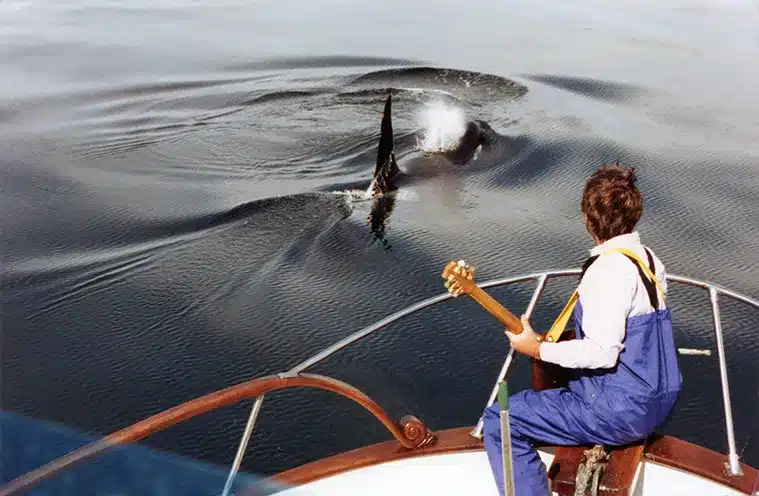
What a fascinating interview with Jim Nollman at PopMatters. Go read that first. Really. Sal Cataldi got some great insights out of Nollman.
Jim Nollman played electric guitar to orcas at night, underwater, by candlelight. The candles were not a mood. All the battery power went to the sound system, so the humans got wax.
He did this for summers on end at Johnstone Strait in British Columbia, on a chartered 42-foot cabin cruiser rigged into an underwater recording studio. Then he’d go home and put the tapes on a shelf in his studio. Without listening to them. Sixty hours of that, sitting there for decades, until Folkways asked him for 45 minutes of it. When he finally sat down with the tapes, he found interactions he’d never heard before that were, in his words, “far more worthy than I imagined.”
I can relate. My photos go onto a hard drive and that’s usually the last anyone sees of them. Then I need one specific picture for something, I go digging, and I keep surfacing good ones I forgot I took. (One way to force the dig: search your Google Photos archive for the Word of the Day. Type the word in, see what comes up.)
Back to Nollman. He tried to record in stereo and couldn’t. The two hydrophones were eight feet apart in the water column, and eight feet wasn’t enough separation. Sound travels 4.5 times faster in water than through air, so the two mics hear the same event almost simultaneously. No gap, no stereo image. The album is mostly monaural because water is too fast.
Eight feet in air is a stereo field. Eight feet underwater is one dot.
So how far apart do the hydrophones have to go? Thirty-six feet? More? Does the boat have to get bigger, or do you need two boats? Is there a person whose whole job is deciding where to hang the second microphone in an ocean? (My napkin math is almost certainly wrong here. I’d love to be corrected by someone who actually does this.)
Two other things from the interview I want to write down before I lose them.
One: orca calls often sit in the key of D. One stereotypical Johnstone Strait call goes D to C to D.
Two: the orcas don’t care about virtuosity. Nollman says a perfectly played Mozart did nothing for them. What worked was groove — Indian ragas on an open-tuned electric guitar, and then a James Brown riff, the Jimmy Nolan one, played underwater by Jim Nollman. He called the track “The Three Jimmies” because the orcas answered back sounding like Hendrix.
A rhythm crossed a species line. Mozart didn’t.
I love that the wolves were even stricter. Nollman played shakuhachi with a wolf chorus, and if he drifted out of tune they’d get agitated and quit on him. Imagine an audience that walks out on pitch alone.
There’s a lot more in there that I’m leaving alone on purpose — the 300 turkeys, the kangaroo rats in Death Valley drumming on their own burrows, the Tibetan monks who chanted from the deck for three seasons. Those are in the interview. Read it at PopMatters.
If you got one night on that boat with the speaker in the water, what would you play?