

I’ve been keeping a tab open longer than usual.
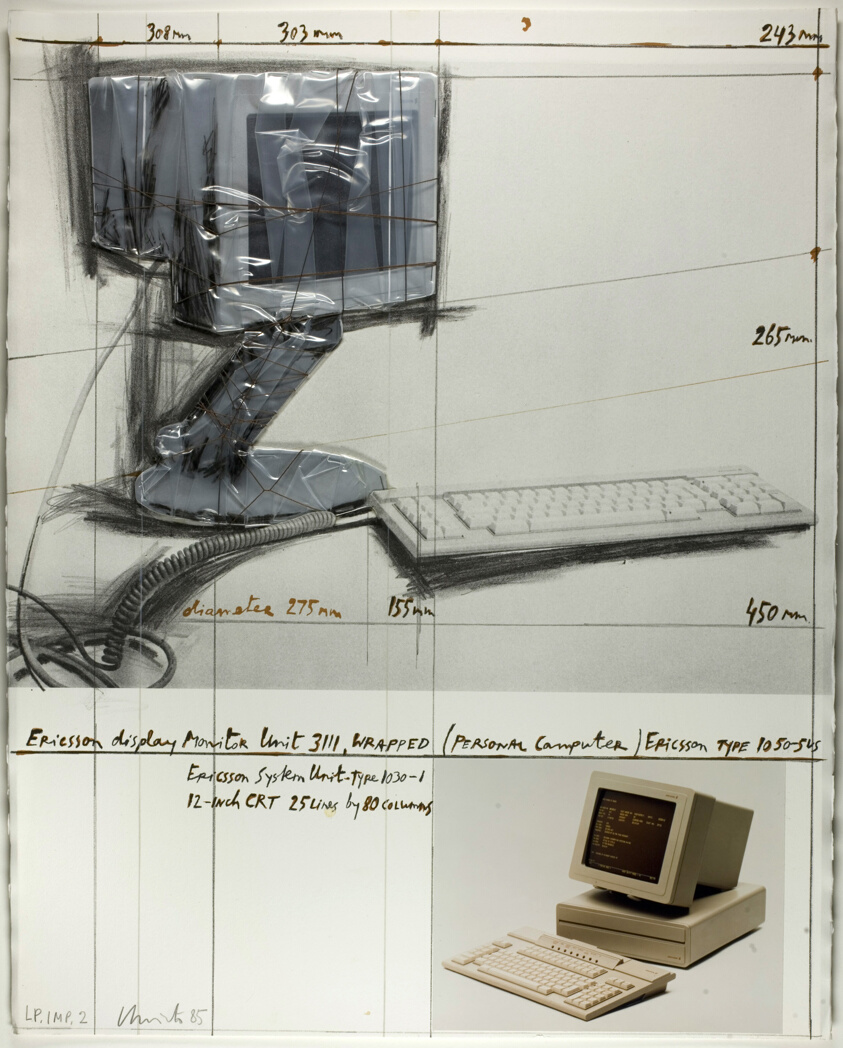
In this case, it’s a Christo and Jeanne-Claude piece from the Art Institute of Chicago: Ericsson Display Monitor Unit 3111, Wrapped, Project for Personal Computer.
Christo is a familiar name. Even if you don’t know it, you probably know the work: buildings wrapped in fabric, bridges veiled, coastlines outlined. In the late 1990s, when I was in college, I loved how those projects took ordinary, overlooked things and made them unavoidable. He didn’t just make art for museums. He made art that everyday people had to talk about.
But now, some decades later, it’s been a while since I really sat down and pondered a Christo artwork. This wrapping action comes to me as a fresh concept once again.
At first glance, it’s a computer wrapped in plastic and twine. But it’s not actually a wrapped computer. It’s a print of a wrapped computer. Christo did this often—making drawings and prints as proposals, then selling them to fund the larger public projects.
Already, there’s a tension. It’s a computer, but it isn’t. It looks functional, but it can’t be used. It sits in that narrow space between object and idea, and that space is where my curiosity lives.
Then there’s the subject itself. A wrapped computer.
Wrapping usually does two opposite things at once. It protects, and it prevents. You wrap something because you care about it, but once it’s wrapped, you can’t use it. The computer’s entire reason for being—displaying information, responding to input—is suspended.
Is this an act of preservation? A kind of obsessive care, like plastic covers on couches or lampshades, meant to keep things pristine at the cost of enjoyment? Or is it an act of interruption, deliberately shutting down a machine built for constant activity?
The twine complicates things further. Twine suggests shipping. Transit. The object is going somewhere, but we don’t know where. It’s between locations, between states, between purposes.
Everything about this is in-between.
Notice how the wrapping changes from print to print. The plastic shifts. The folds are different. The tension of the string varies. The computer is the same, but the wrapping is not.

artic.edu
georgetownframeshoppe.com
liveauctioneers.com
bukowskis
mutualart.com
artnet.com
wright20.com
christies.com
sothebys.com
van-ham.com
The variations in the plastic are almost like brushstrokes. Each fold is different, each crease the result of a specific moment of pressure or pull. The idea may be repeatable, but the surface never truly is.
The computer represents standardization and precision. The wrapping introduces variability and the hand of the maker. Even when the idea is the same, the execution never quite is.
Maybe what really sticks out to me is the vintage vibe. This is a CRT monitor, the kind I remember using in the late 1990s and early 2000s. Just looking at it, I can feel its physical presence. The literal weight of it. These things were heavy. They took up space. They announced themselves on a desk.
The thin plastic wrapping does something strange to that memory. It makes the object feel lighter, almost fragile, even though I know it isn’t. My body remembers the heft, but my eyes are being told a different story.
It’s in-between again.
These prints were made in 1985, when this monitor would have been high-tech, not nostalgic. For Christo, this wasn’t about looking backward. It was about the cutting edge.
Computers carried a kind of unease then. They were feared as job-stealers, cold replacements for human labor. In some ways, that fear wasn’t wrong—but it also wasn’t complete. Computers didn’t just erase jobs; they reshaped them. Work moved from paper to screens. From physical to abstract.
Wrapping a computer at that moment feels especially loaded. It pauses a machine built for efficiency and progress. It slows it down. It turns something meant to accelerate work into something that can only be looked at.
I think that’s why this piece has lingered with me. It’s quiet, especially compared to Christo’s monumental public works. But it asks a lot of small, persistent questions.
The in-between nature of this artwork asks some questions:
When does protection become denial?
And how much meaning lives not in the object itself, but in what we choose to do to it?
For now, I’m still keeping the tab open.