

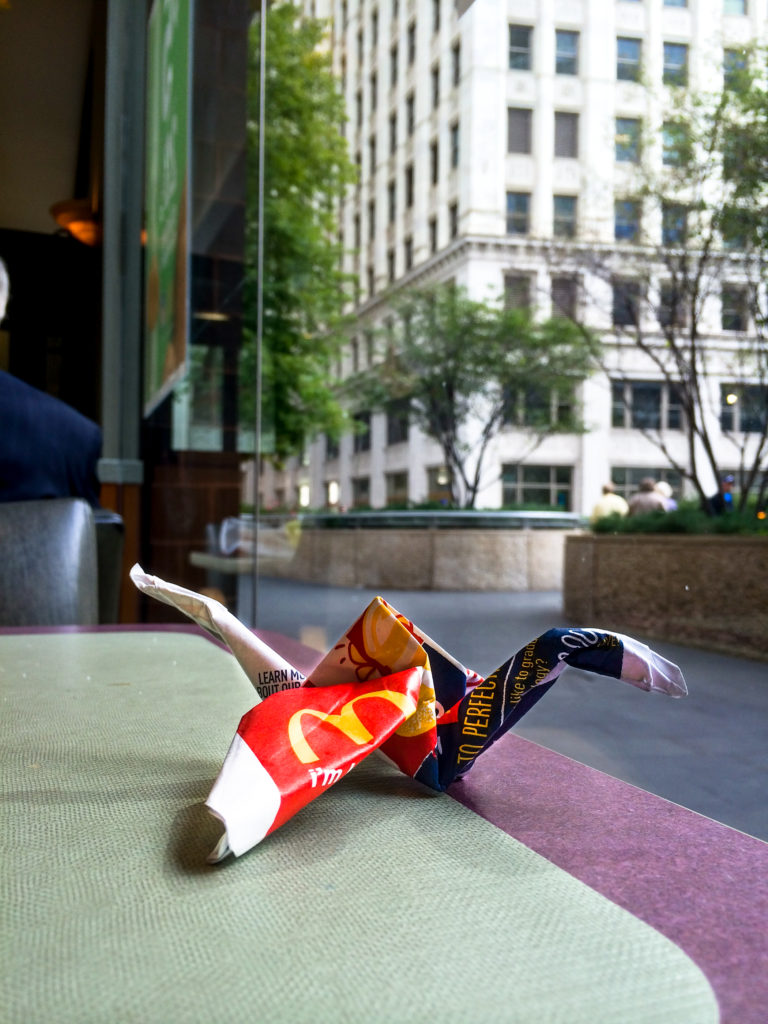
99.9% of America throws away the fast food paper bag.
It’s paper. Good paper. Your burger came in its own wrapper, and your fries came in their own carton, so the bag never touched a thing you ate. It carried the packages from the counter to your table. Now the original function of the bag ended once you sat down.
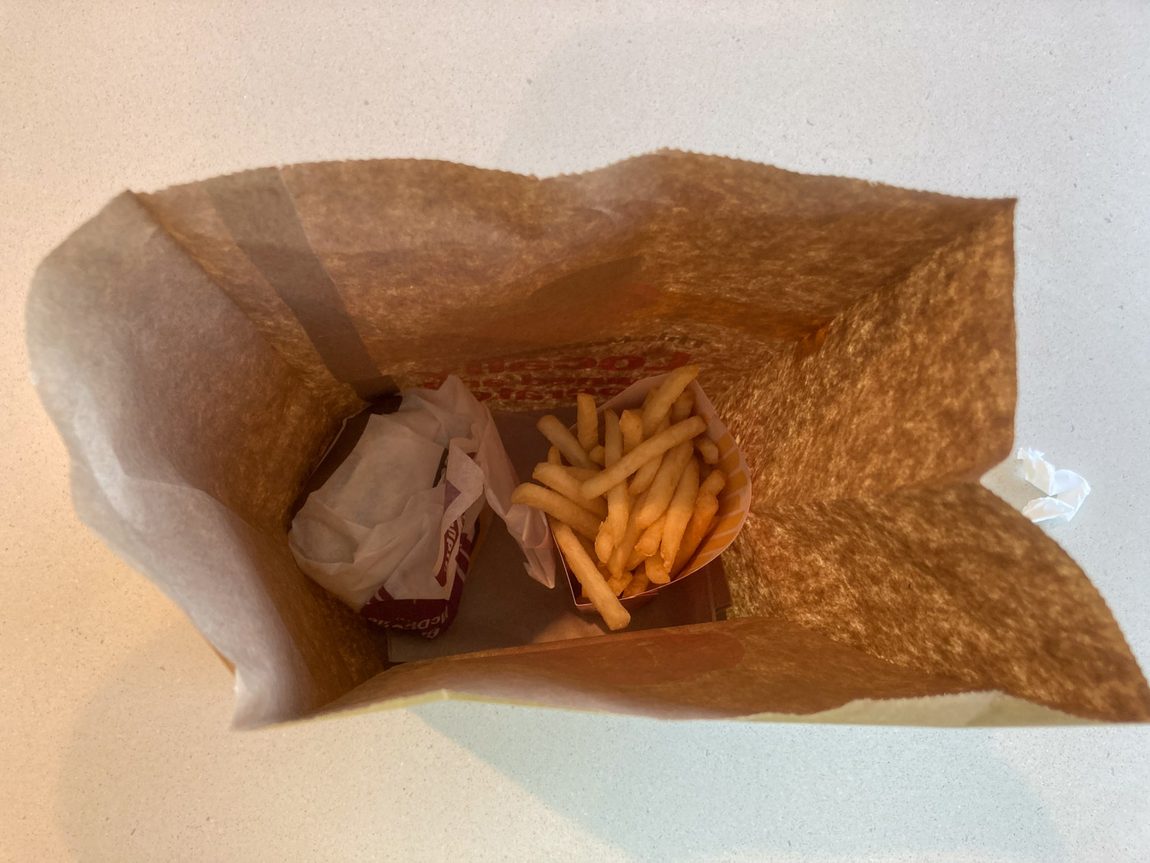
So I folded mine into a crane at the McDonald’s next to the Wrigley Building. Ripped it square, kept the arches inside the square, and folded the crane I know how to fold. Then I set it on the garbage can outside and squatted behind that can for 10 minutes getting the picture.
In 2017 I wrote that up as a recycling idea. Which I still stand behind. Most people throw their paper bag into the waste bin.
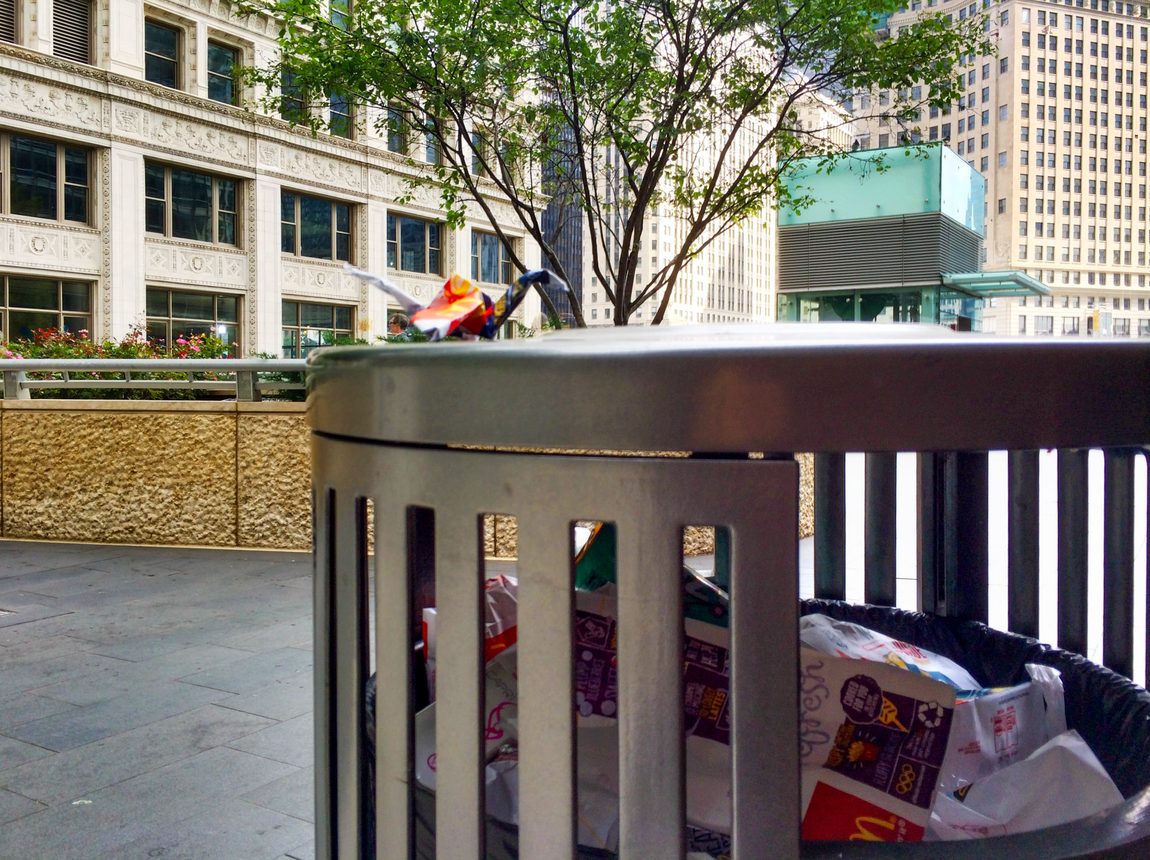
That should be recycled! It’s paper! I would bring my empty bag back to the office to put into the recycling bin.
Nine years later, I’ve been thinking about this project again. Especially as I build out the spudart.org/try section. National Origami Day is November 11th. I’m encouraging everyone to make an annual tradition in November of folding a fast food paper bag into origami.
Looking at this project in light of art theory, this project has strong aspects beyond recycling.
Nothing gets added in the fold
My twin brother Erik asked the question in the comments on Flickr:
When a McDonalds bag gets folded into origami, does it stop being a bag? Is it a bird now? Does the thing have a dual ontology?
Look at what actually happens in a fold. No paint. No glue. No cutting, except tearing a square shape out of the bag. Every gram of that crane is still a McDonald’s bag.
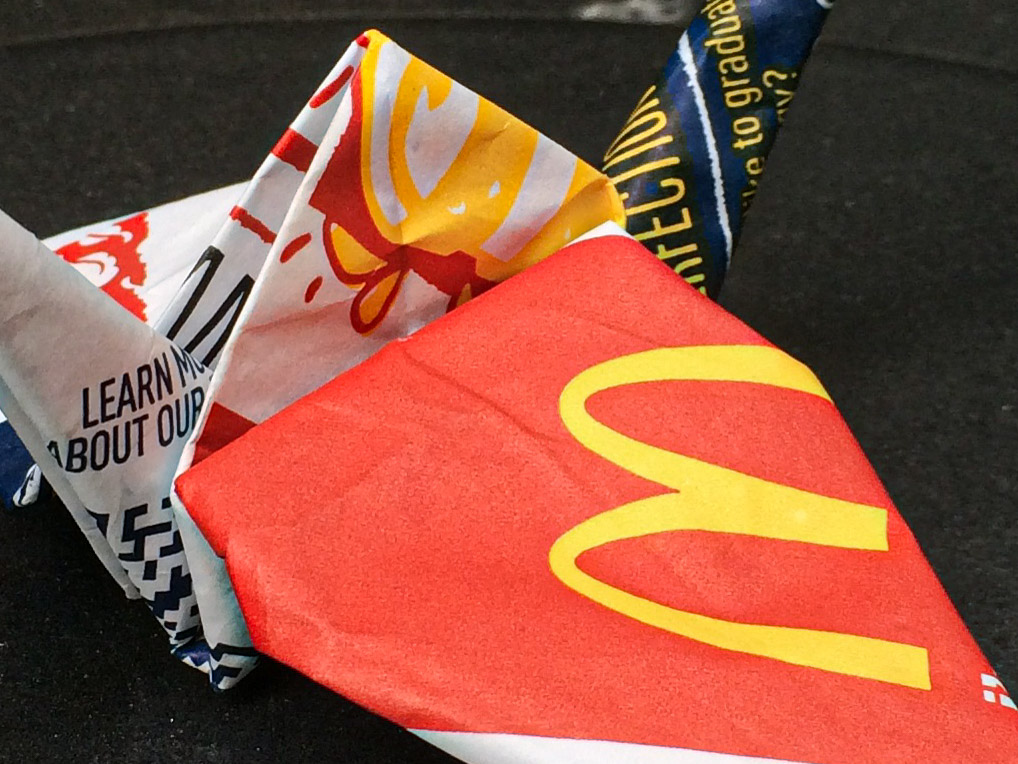
And nobody would hand it to you and call it a bag.
The creases made it into something other than a bag.
Fast food is about speed. Origami is about slowing down.
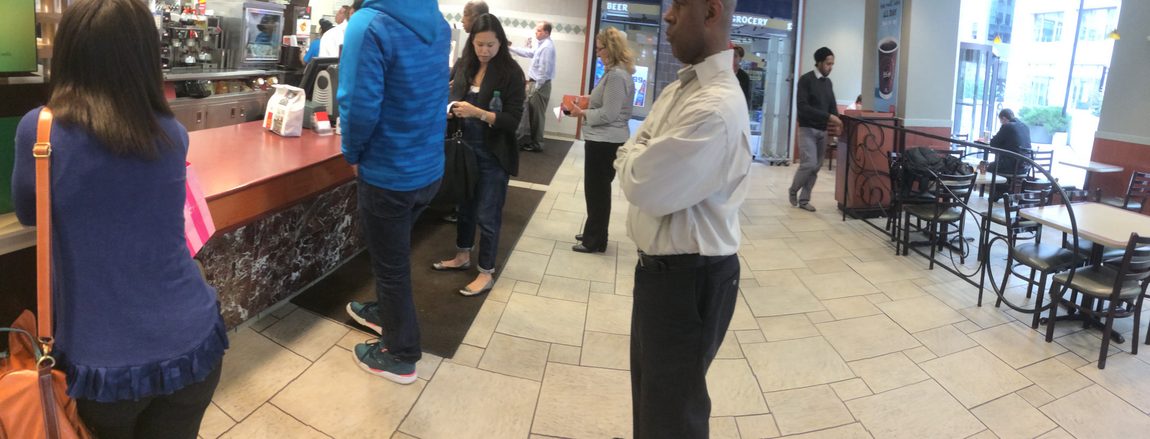
Think about what a McDonald’s is engineered to do. Order fast. Cook fast. Hand it over fast. Wipe the table down and get the next person into the seat. Every surface in that building is easy to clean and easy to leave.
Now think about what folding paper is engineered to do. Nothing fast. You need your hands, a flat surface, and a bit of additional time.
The bag fits into the process meant for speed. Carry that bag outta there! Get out of that restaurant as fast as you can! Here’s a bag to carry all your food, so you don’t have to make multiple trips. Get outta here!
But with the origami, a person sits down and does the slowest possible thing to it.
Buy, eat, throw away. That’s the standard pattern. Buy, eat, fold, look at it, leave it on the table. That’s a different pattern that makes you slow down.
How long does it take you to eat a fast food meal? Have you ever timed it? What would you do with four extra minutes at that table? Stare at your phone? Heck, you probably were staring at your phone while gulping down the food.
When you fold the origami, it not only slows you down; it also makes you take your hands off your food. I found one of the best ways of slowing down my eating was to put my hamburger down after every bite. If you keep that burger in your hands, it’ll be gone before you know it.
But that act of setting down the burger. Then picking it up again. You pick up the weight. You feel it. You get a sense of where you are in the meal.
Folding an origami while you eat forces you to put your food down.
McDonald’s paper is a different thing from paper
If this were really about recycling, I could use any waste paper. A newspaper. A flyer. The back of the school lunch calendar. Those are all fine.
A McDonald’s bag arrives loaded. The arches, the font, the advertising, the whole memory of being seven years old in one of those booths. Over the years, a lot of thought has gone into the branding of fast-food restaurants. The branding creates familiarity and routine. They want the design of their bags to carry more than just the food. That design carries the ethos of McDonald’s. Of Taco Bell.
You are folding material that is loaded with existing meaning.
The Smithsonian has a McDonald’s bag in a drawer
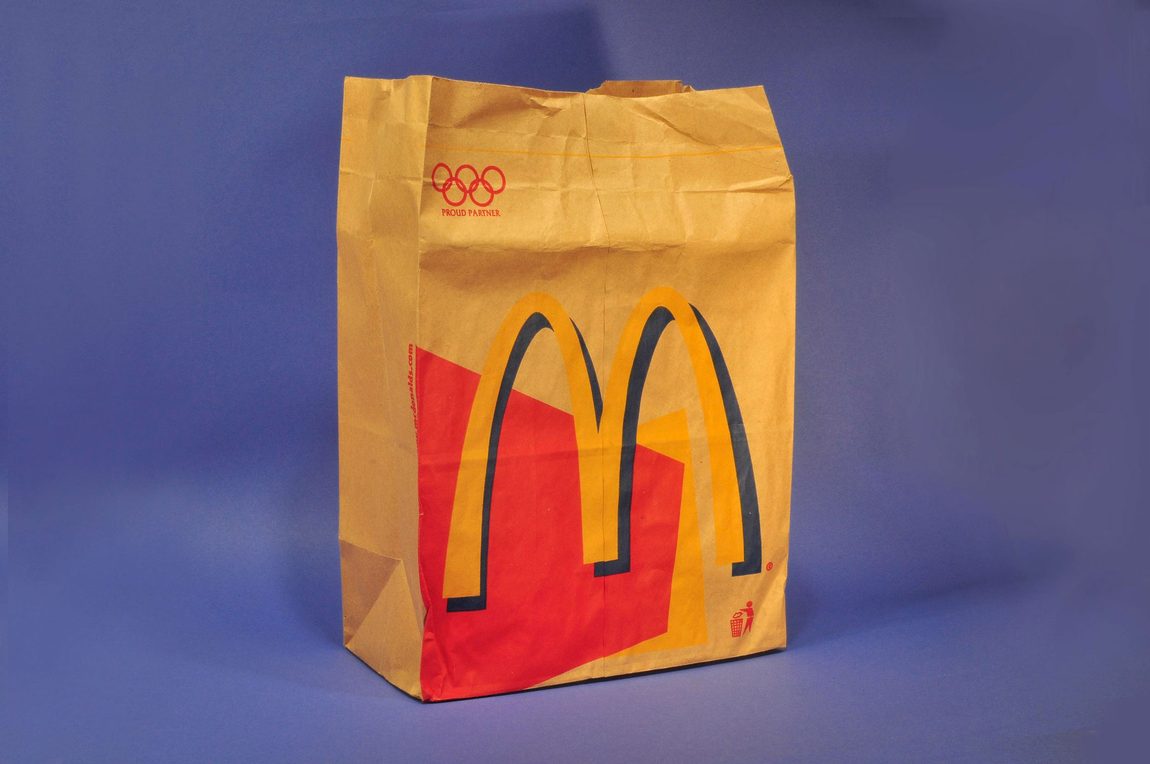
The National Museum of American History has a large brown McDonald’s bag in its collection. Golden arches on the front. “Proud partner” of the Olympics on the side, with the five rings sitting where the word Olympics should be. Copyrighted in 1995. The record lists the object name as, simply, bag.
Measurements: 16 3/4 inches by 11 5/8 inches by 6 3/4 inches.
Somebody at the Smithsonian measured a McDonald’s bag to the eighth of an inch.
Location: currently not on view.
So the bag I tore into a square that afternoon has a cousin in a museum’s storage. The one I’m folding started in the same place. A McDonald’s. But now it’s becoming a sculpture. Then it’ll become a photograph. It’ll become a discovery for someone. Who knows what they’ll do next. Hopefully, they’ll be amused by this transformation. Maybe show it to a friend or coworker. Maybe it’ll end up in someone’s desk drawer as a reminder that you can take something every day and make it into a wonder.
The arches go into the crane with everything else
Keep the logo inside your square. I said that in the original post because the crane looks better that way, which is true, and there’s more to it than looks.
Warhol painted the soup can over and over until you had to look at it.
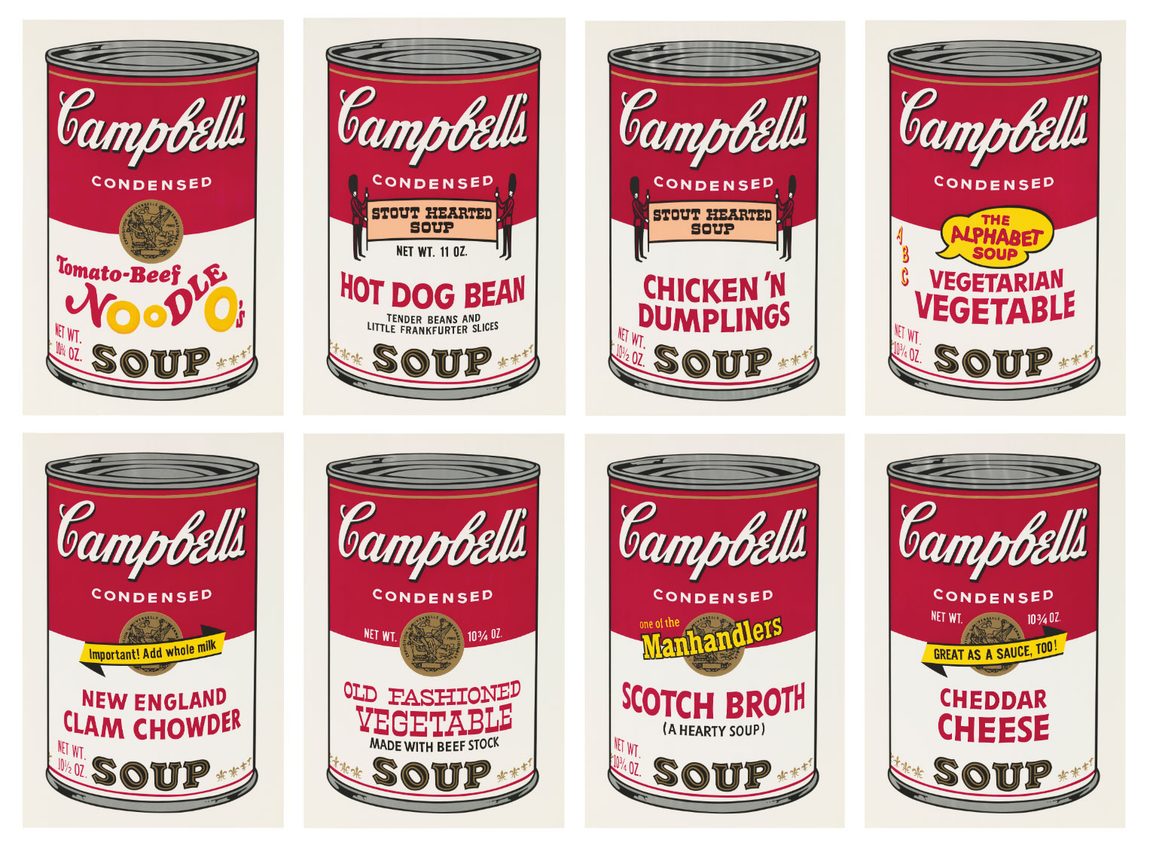
This origami project goes a different way. You take the commercial image, and you physically bend it. The arches curve over a wing. Words snap in half at a crease. The corporate graphic ends up part of the anatomy.
McDonald’s paid for that ink so you would think about McDonald’s. Now it’s a bird standing on a garbage can lid in a stranger’s photo feed.
The bag says McDonald’s. The crane asks what else this could be.
Origata, 1697, also not on view
Paper folding didn’t start out as a craft store activity. The Met has an album from 1697 called Models of Paper Folding, origata tehon.
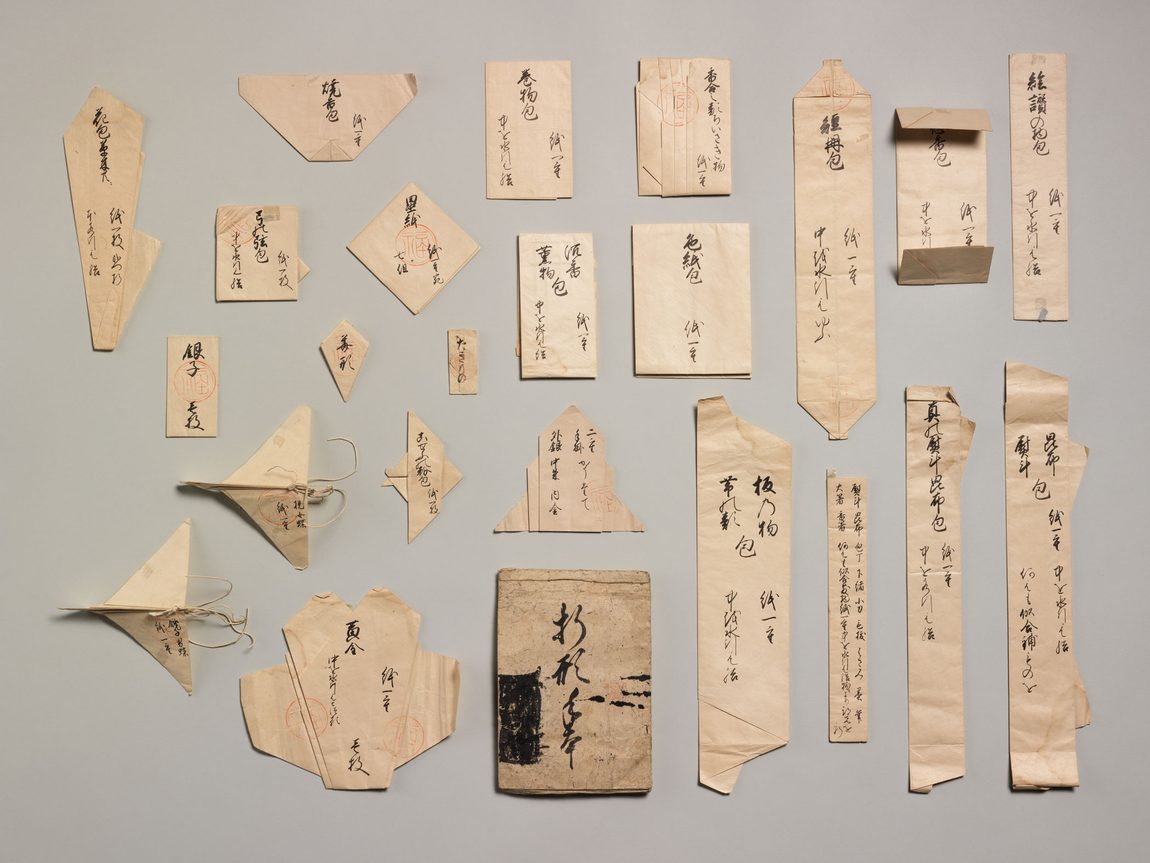
Origata was formal wrapping, and knowing how to do it was expected of aristocrats and high-ranking warriors. The techniques were passed along out loud, teacher to student, with nothing written down. That album was somebody’s initiation set. An Ogasawara school master gave it to a student named Kikuchi Fujiwara no Takehide in the third month of 1697. Origami as we know it grew out of origata.
The Ogasawara school was teaching people how to fold paper properly a good 250 years before Ray Kroc opened his first franchise in Illinois in 1955.
(And that album is currently not on view either.)
Folding is a language. It has vocabulary and canonical forms and experts and beginners and people who teach it to other people. Which means fast-food origami could develop its own dialect. What creature does a Wendy’s bag want to be? Does a Taco Bell bag fold differently than a Chick-fil-A bag?
A few minutes that make no economic sense
Trace the bag backward. Tree, pulp, paper mill, printing, bag factory, truck, storage room, front counter, your hands. An enormous amount of engineering aimed at getting one paper bag to you cheaply and fast.
Then you sit there and spend a few minutes folding it into a duck.
The photograph endures
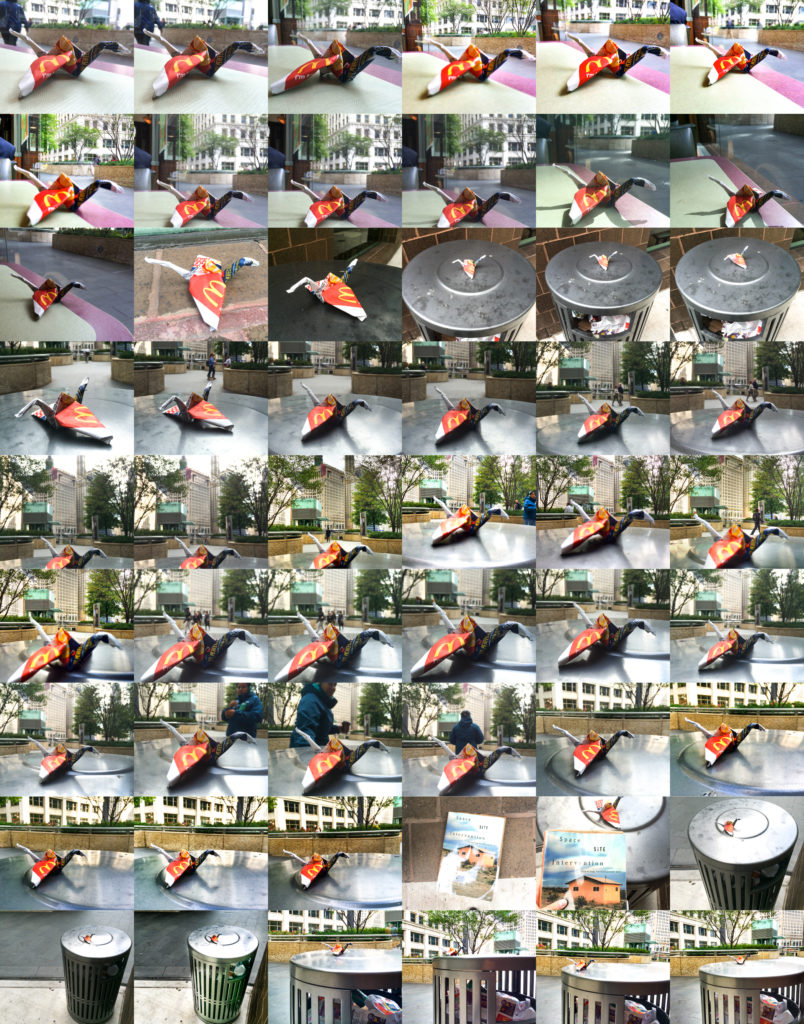
The crane is paper sitting on a public table. Somebody wipes that table.
So the project is the bag, the folding, the object, the place it sat, and the photograph. Only one of those survives the day.
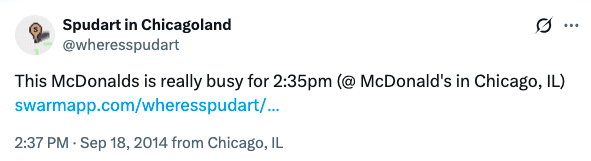
The main photo got over 12,000 views on Flickr and climbed into Explore, the top 500 photos posted for that day, ranked as high as #237 on September 18, 2014. The photo endured. The crane did not.
Leaving it behind is where it gets good
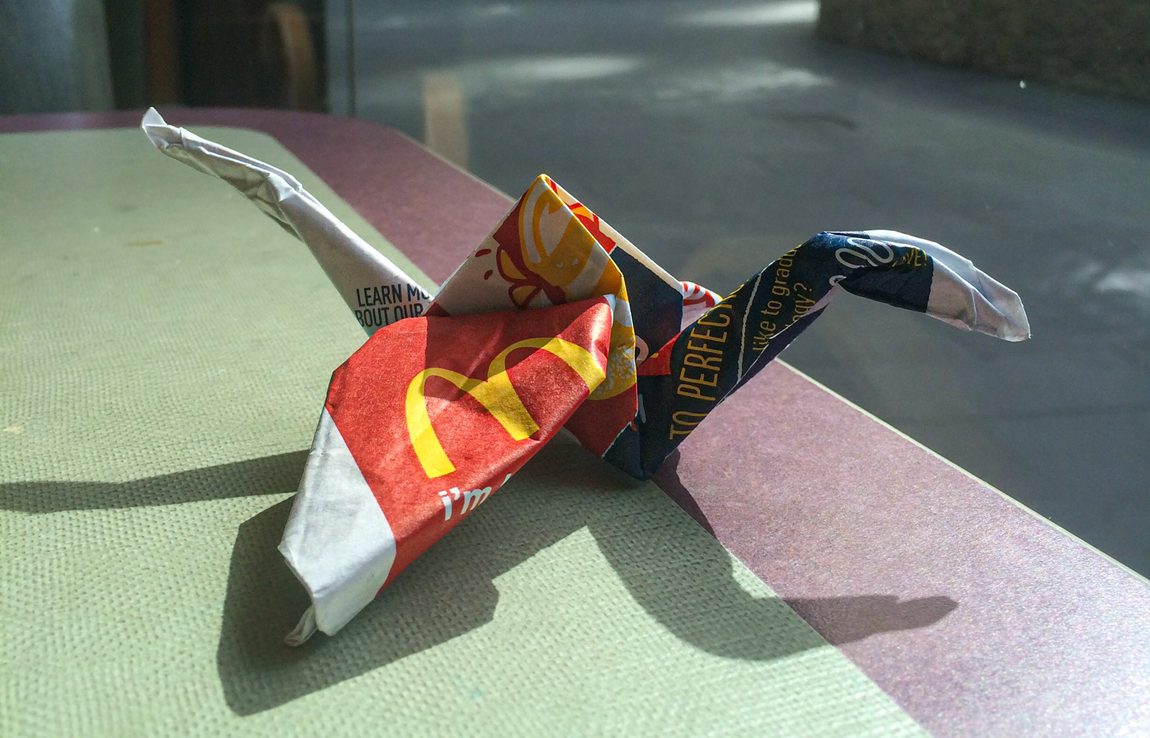
Leave the crane on the table when you go. Now somebody who didn’t order it has to decide what it is.
Do they throw it away? Photograph it? Unfold it to see how it was done? Assume it’s trash, which it was fifteen minutes earlier?
I go back and forth on this one. If a crew member sweeps my crane into the bin, did they destroy the artwork or complete it? That bag was headed for that bin the whole time. The crane just took the scenic route.
As I said earlier, there is a slight chance someone keeps it. At very least, I hope someone is amused by it.
The woman at the garbage can

While I was photographing, a woman came up to throw something away and found a guy crouched behind a garbage can downtown, aiming a phone at what looked like a folded-up fast food bag.
She hesitated. Then she threw her garbage away and walked off.
She was standing in front of a paper object that had been garbage, then material, then sculpture, and none of that was visible from where she stood. To her, it was a man photographing trash. She wasn’t wrong about the raw materials.
The whole story is over in the blog post.
What if everyone did it
Back in 2015, I asked what would happen if our culture made it a tradition to always fold your paper receipt into an origami creature.
Imagine all the origami that would be created. McDonald’s workers would always be cleaning up origami creatures every day. Buckets and buckets of origami would be created at every restaurant and store every day.
People would become proficient masters of creating origami. People would share new techniques on how to make different and creative creatures. Everyone would learn the language of folding.
Everyone would realize the potential in small little things, like a simple paper receipt.
I’d use ‘transformation’ instead of ‘recycling’
My original post gave a whole section to recycling fast food paper bags. It’s much more than recycling. If recycling were the point, any waste paper would do, and the project would be a tip rather than a piece of work.
What I’d say instead: Fast Food Origami takes the paper bag from a fast food restaurant and folds it into a small sculpture. The bag was manufactured for speed and built to be thrown away. Folding is slow and leaves evidence that a person was there. Every crease is a decision somebody made with their hands, on a mass-produced object that was identical to a million others until they touched it.
I plan on folding more of these. There are four Instagram photos with the #fastfoodorigami tag right now (three of them are mine).
Tag yours #fastfoodorigami so I can find it. Did you leave it on the table, or did it come home with you?