

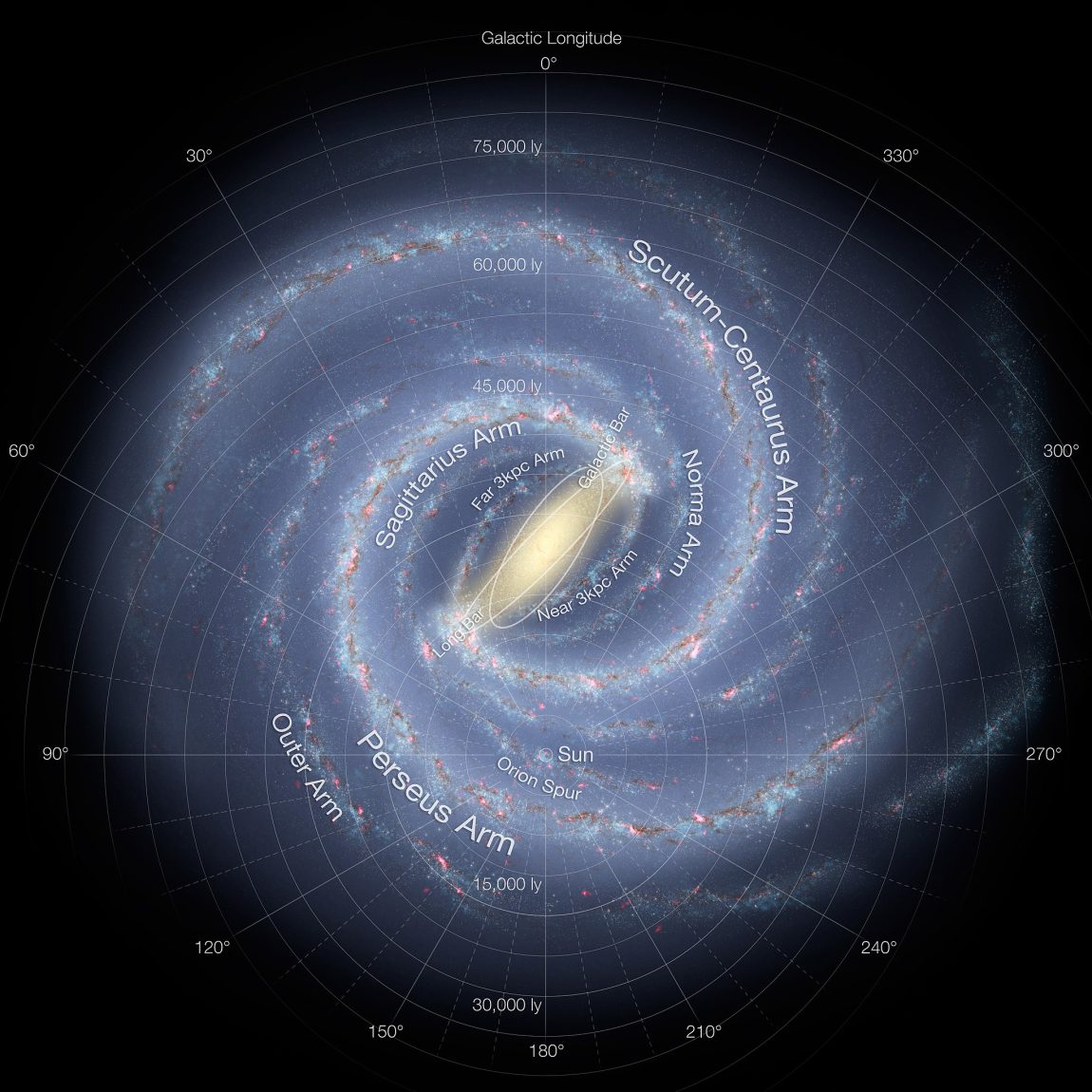
The correct address for our location in the universe would be:
Earth
Solar System
Local Interstellar Cloud
Local Bubble (or should we say “Gould Belt”?)
Orion-Cygnus Arm
MILKY WAY GALAXY
I wrote about our intergalactic address 12 years ago. Today I almost corrected myself by saying we live in the Gould Belt, but not the Local Bubble. But doing a bunch of research, I found that we actually do live in the Local Bubble.
Why do we use Local Bubble and not Gould Belt?
We would use Local Bubble in our address, not Gould Belt, for the following reasons:
Local Bubble
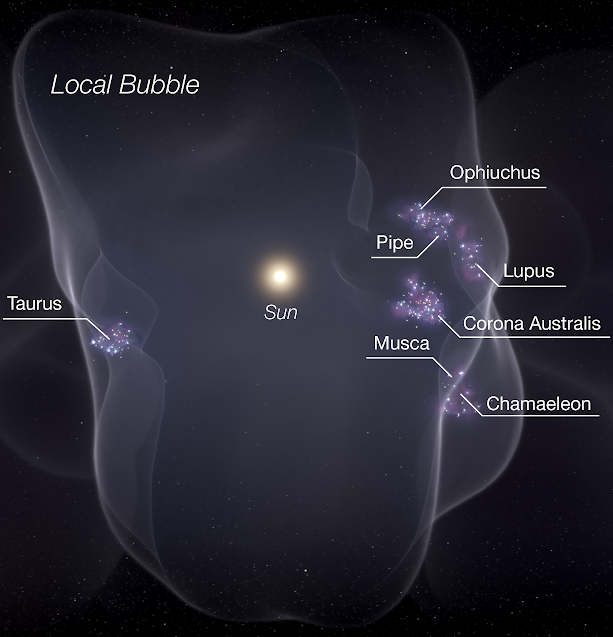
- Shape: The Local Bubble is a lumpy, peanut-shaped void. It is roughly 1,000 light-years high and 300 light-years wide.
- Density: The hydrogen count in the Local Bubble is about 20 times lower than the hydrogen density in the rest of the Milky Way due to supernova explosions that have cleared out space. This makes the Local Bubble a relatively empty region of space.
- Stars: The Local Bubble contains stars, but they are scattered and not concentrated in any particular area. It includes a mix of young stars, older stars, red dwarfs, and background stars. This region isn’t primarily known for active star formation, but the stars are there.
- Solar System’s location: Our Solar System (and Earth) is inside the Local Bubble. We’re passing through this relatively low-density region. The Local Bubble is a significant feature of our location, and we live inside it, so it’s relevant to our intergalactic address.
Gould Belt
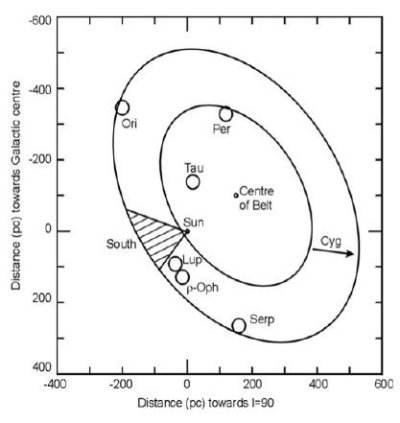
- Shape: The Gould Belt is a ring-shaped structure. It’s about 3,000 light-years wide and 300-400 light-years thick. While it’s called a “belt,” its shape is closer to a ring, or even a disk, which would be a more accurate name. The Gould Belt is a concentration of young, massive stars.
- Stars: The Gould Belt contains around 10,000 stars, most of which are very young. These stars are concentrated along the ring structure, with star formation still occurring in the region.
- Solar System’s location: The Solar System lies near the inside edge of the Gould Belt, but it does not reside within the Gould Belt itself. We are passing through this region, but we don’t live within it. Most of the stars in the Gould Belt are concentrated along the ring, and we are not situated on the ring itself.
Local Bubble vs Gould Belt: which one should we include in our address?
- Local Bubble: The Local Bubble is a void or a lower-density region in space that we live in. It’s the primary feature of the area we inhabit, and it’s appropriate to include in our address.
- Gould Belt: While the Gould Belt is an important feature of our galaxy, the Solar System is not located in it. We are near the inside edge of the Gould Belt, but we are not part of it. Therefore, it should not be included in our intergalactic address.
Why is the Local Bubble important?
The Local Bubble is the region of space in which we live, and it is an area with significantly lower hydrogen density compared to the rest of the Milky Way. This void in the interstellar medium was created by supernova explosions that cleared out space. The stars inside the Local Bubble are scattered, and while we are surrounded by stars, we’re in an area that’s more “empty” than the rest of the galaxy. Our Solar System is moving through this bubble, not formed by it.
Why is the Gould Belt called a “belt”?
The Gould Belt was first identified by astronomer John Gould in the 19th century. It was described as a band of stars along the Milky Way. While the term “belt” was used, the structure is actually more ring-like. Its stars are concentrated in a ring (or disk) shape around the Milky Way. The name “Gould Ring” would be more accurate, but the term “belt” stuck. The Gould Belt contains mostly young stars that are actively forming in a region that spans a large portion of the galaxy.
Ring of stars inside the Gould Belt includes well-known constellations such as:
- Taurus
- Perseus
- Cepheus
- Lacerta
- Scorpius
- Lupus
- Southern Centaurus
- Crux (the Southern Cross)
- Carina
- Vela
- Puppis
- Canis Major
- Orion
Where do we live?
Our Solar System is located in the Local Bubble, which is a low-density region of space. We are not in the Gould Belt, but rather we are passing through it as we move along the Milky Way’s spiral arms. Because the Local Bubble is the area we live in, it should be included in our intergalactic address, while the Gould Belt should not.
Side-note
I could not find ANY images that showed the location of the Sun inside both the Local Bubble and the Gould Belt. Very odd. This is where we live in the galaxy. How has nobody made a mockup of this map yet? If you find one, please let me know (either in the comments on this post or via my contact form.)
Other parts of our address
As a review, here’s our intergalactic address:
Earth
Solar System
Local Interstellar Cloud (LIC)
Local Bubble (not Gould Belt)
Orion-Cygnus Arm
MILKY WAY GALAXY
Ok, so we’ve covered the Local Bubble part. Now let’s look at Local Interstellar Cloud (LIC)
Local Interstellar Cloud (LIC)
The LIC is a small cloud (~30 light years across) within the larger Local Bubble. The Solar System is expected to exit the LIC within a few thousand years (astronomically soon). So, it’s temporary compared to the Local Bubble.
Missing layer in address?
If we really want to go further beyond the Milky Way Galaxy, some people also include the Local Group (our small cluster of galaxies that includes Andromeda, Triangulum, etc.) and the Laniakea Supercluster above “Milky Way Galaxy.”
Our modified intergalactic address would look like this:
Earth
Solar System
Local Interstellar Cloud (LIC)
Local Bubble (not Gould Belt)
Orion-Cygnus Arm
Milky Way Galaxy
Local Group
Laniakea Supercluster
Local Group
- What it is: A galaxy group — a small gravitationally bound collection of galaxies.
- Size: ~10 million light years across.
- Members: About 80 galaxies. The main ones are:
- Milky Way, Andromeda Galaxy (M31), Triangulum Galaxy (M33), plus dozens of dwarf galaxies (e.g., Large and Small Magellanic Clouds).
- Gravitationally bound: These galaxies are held together strongly enough by gravity that they will interact and merge over billions of years (e.g., Milky Way and Andromeda are on course to merge in ~4–5 billion years).
Think of it as our immediate galaxy neighborhood.
Laniakea Supercluster
- What it is: A supercluster — a massive, much larger region of the universe containing many galaxy groups and clusters.
- Size: ~500 million light years across.
- Members: About 100,000 galaxies.
- Includes: The Local Group is just one tiny part of Laniakea. Other major components include the Virgo Cluster and Hydra–Centaurus.
- Not strongly bound: Unlike the Local Group, the Laniakea Supercluster is defined more by the flow of galaxies (how they move relative to each other) rather than being tightly gravitationally bound. On the largest scales, dark energy is pulling superclusters apart, so Laniakea isn’t a permanent “object” in the way the Local Group is.
Think of it as our galactic address district in the larger cosmic web.
By the way, prior to 2014 this used to be known as the Virgo Supercluster. Astronomers used “Virgo Supercluster” for decades, but it turned out to be an incomplete picture — it only described a portion of a much larger structure. Our Local Group (Milky Way, Andromeda, Triangulum, + dwarf galaxies) lies on the outskirts of the Virgo Supercluster.
Analogy
- Local Group = your neighborhood (a few dozen houses).
- Laniakea Supercluster = your metropolitan region (millions of people spread across many neighborhoods, towns, and cities).
Note: I didn’t even include the last two lines of the address:
Earth
Solar System
Local Interstellar Cloud (LIC)
Local Bubble
Orion–Cygnus Arm (Orion Spur)
Milky Way Galaxy
Local Group
Virgo Supercluster (edge)
Laniakea Supercluster
Cosmic Web
Observable Universe
Looking at images of the Cosmic Web got me thinking. If you are traveling through the Cosmic Web at whatever, a crazy bajillion majillion light years a second. So you are going from one end of the Cosmic Web to the other end of the Cosmic Web.
Would you like to go to the parts that have all the galaxies? Or do you want to travel through the empty parts? An image of the cosmic web resembles a network of roads. My inclination to travel along those roads. But maybe it’s better to travel off-roading in this case.
The galaxy roads are like busy traffic: stars, radiation, black holes — lots of hazards. More gravitational turbulence to deal with.
Although those gravitational turbo-boost slings might be worth it.