

I love old camera phone photography. Here’s a shot I captured in 2006 with my Motorola VX-6000.
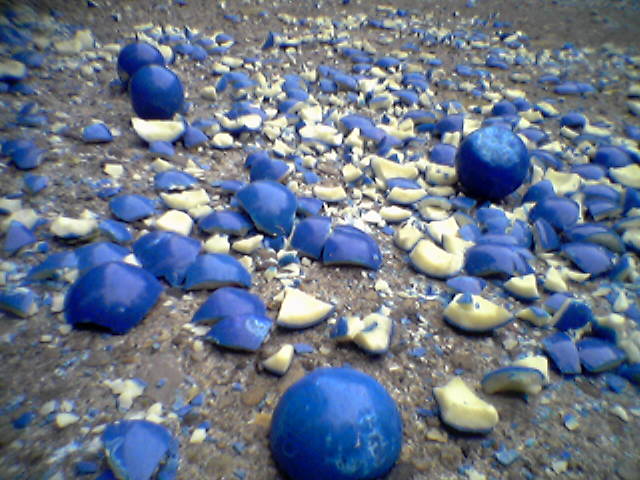
In a Chicago alley behind my Lincoln Square apartment lay a scattered collection of blue gumballs, some whole, some shattered, creating an almost otherworldly scene on the concrete ground.
The vibrant blue spheres against the grey pavement struck me as remarkable. Each intact gumball looked like its own tiny planet, and the scattered pieces formed what appeared to be a miniature galaxy of broken worlds.
I decided to test various AI systems’ ability to identify this image. I presented the photo to ChatGPT, Google Gemini, Microsoft Copilot, and Claude. I asked the same question, “what does this look like?”
Not a single AI system recognized these objects for what they really were – simple gumballs on the ground.
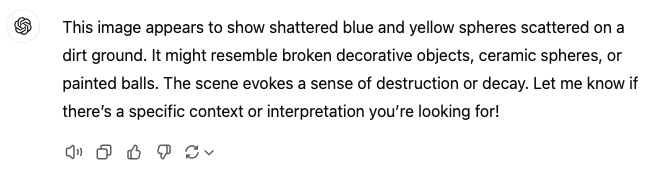
- ChatGPT: broken decorative objects, ceramic spheres, or painted balls
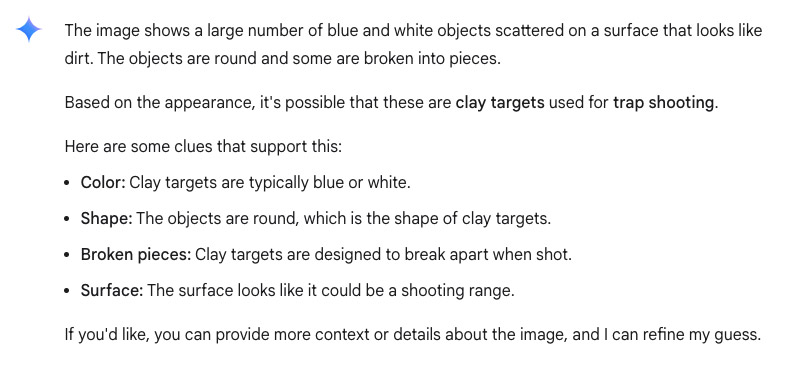
- Google Gemini: clay targets from a shooting range
- Microsoft Copilot: spherical objects
- Claude: blue and white ceramic pieces
The details of each answer:
Chat GPT
Google Gemini
Microsoft Copilot
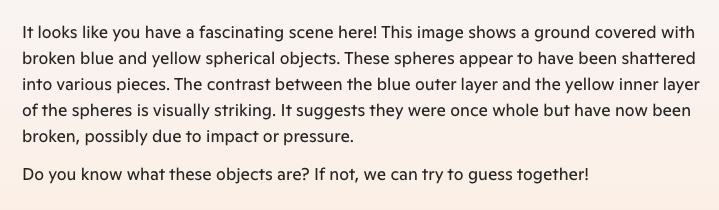
Claude
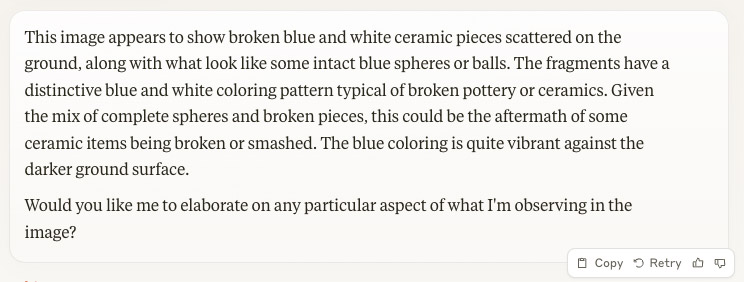
Even our most advanced AI systems can miss what’s right in front of them, transforming an unual scene of spilled candy into mundane spheres and ceramics. Perhaps there’s something poetic about that too — just as my old Motorola phone transformed an alley scene into a galaxy of broken worlds, AI transformed simple gumballs into something more mundane.
Sometimes the most interesting perspectives come from these layers of interpretation, whether through the lens of a 2006 camera phone or the algorithms of 2025’s artificial intelligence.