

I often wonder how artworks get into a museum’s collection. Like this print titled “Sprawled Figure” by Robert W. Mallary from 1962. It appeared today in my ArtTab Chrome extension.
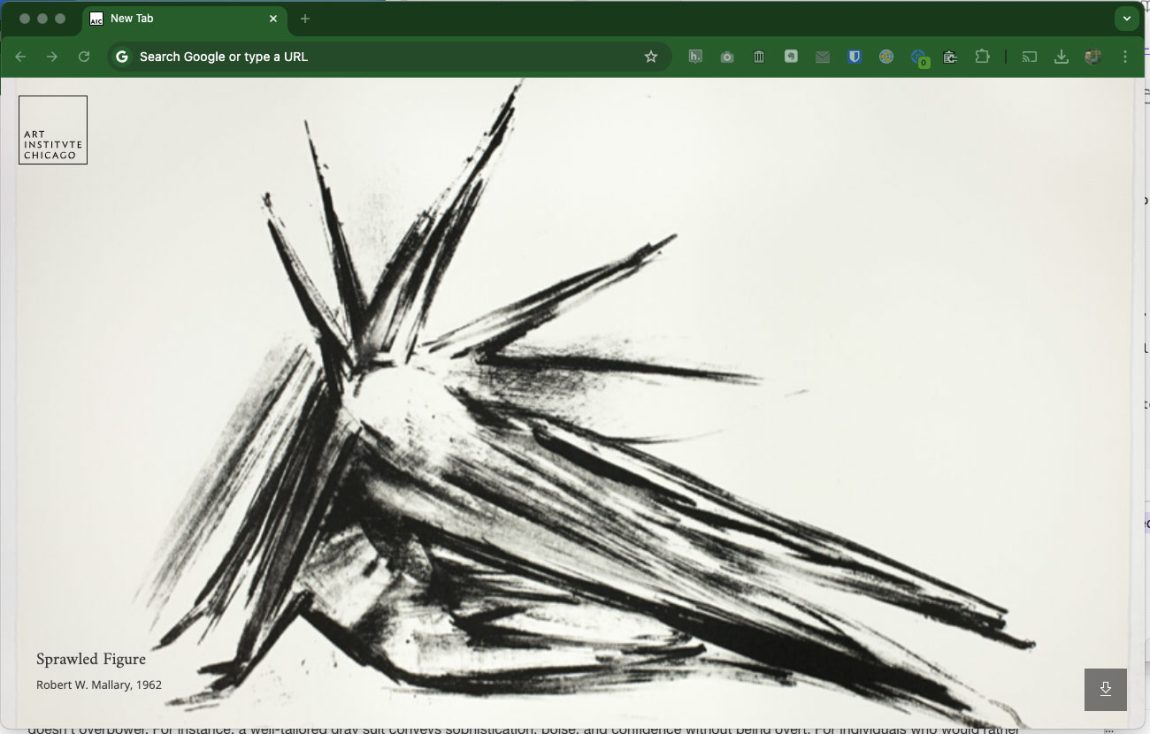
This print was added to the Art Institute of Chicago’s collection in 1963. So pretty much as soon as this print was made, it was in their collection.
I don’t want to revert to the “I could do that” mentality. But I often wonder what artworks being created today are being added to museum collections.
Who is this Robert W. Mallary? In this case, he sounds like an interesting person.
From the Wikipedia page on Robert Mallary
Robert W. Mallary (December 2, 1917 – February 10, 1997) was an American abstract expressionist sculptor and pioneer in computer art. In the 1950s and 1960s, he was renowned for his Neo-Dada or “junk art” sculpture, created from found materials and urban detritus, pieced together with hardened liquid plastics and resins. Mallary’s work is represented in permanent collections such as the Museum of Modern Art, the Whitney Museum of American Art, the National Gallery of Art in Washington, D.C., as well as the Victoria and Albert Museum and the Tate Modern in London.
In 1968, Mallary created one of the first (perhaps the first) digitally modeled sculptures, Quad 1.[1] This work was shown at the landmark “Cybernetic Serendipity” exhibit at the Institute of Contemporary Arts in London. A subsequent work, Quad 3, was displayed at the Whitney Museum’s 1968 Annual Exhibition of Contemporary American Sculpture.[2]
In particular what interests me is his being a pioneer of digitally-modeled sculptures. And how that came from a background of making “junk art” from from found materials and urban detritus. (I had to look up what detritus means. It’s debris or waste, or the remains of something that has broken down)