


Today marked the first snowfall of the year, and I couldn’t resist capturing the snow coming down. Using the Slow Shutter Cam app on my iOS device, I captured this scene from my front window. Interestingly, this app ranks #10 in the Photo & Video category on the iOS App Store – a handy little tool I’ve used since 2010.
My Camera Settings
- Capture Mode: Light Trail
- Light Sensitivity: Full
- Shutter Speed: 15 seconds
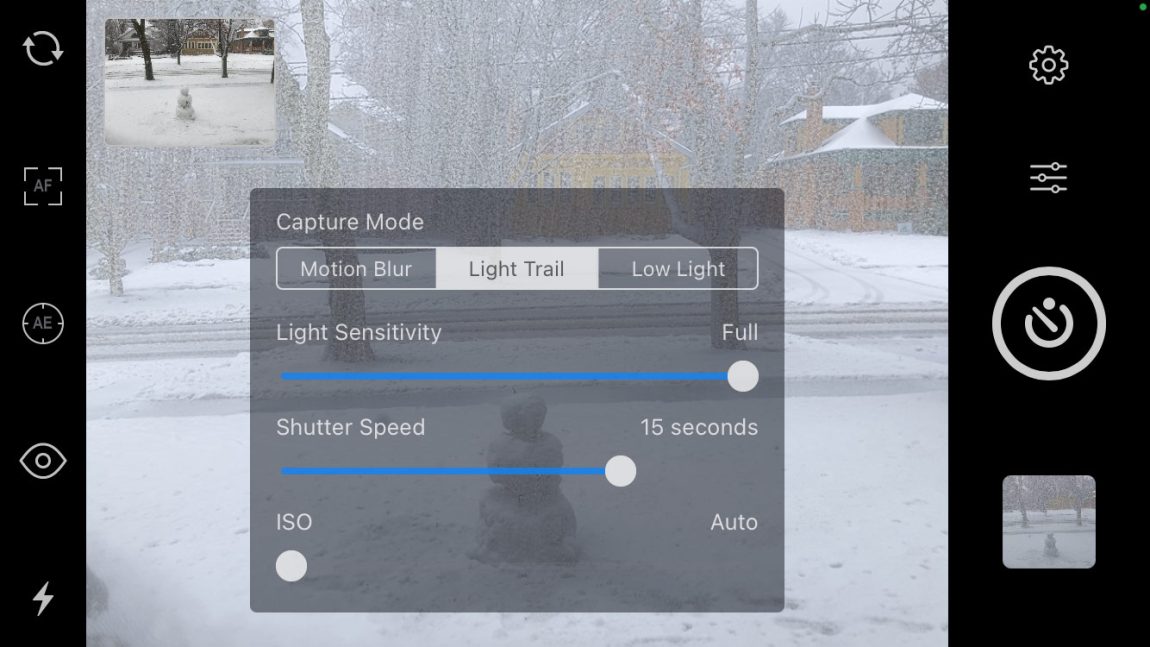
If I tried to photograph the falling snow with a traditional long exposure, the snow would just disappear.
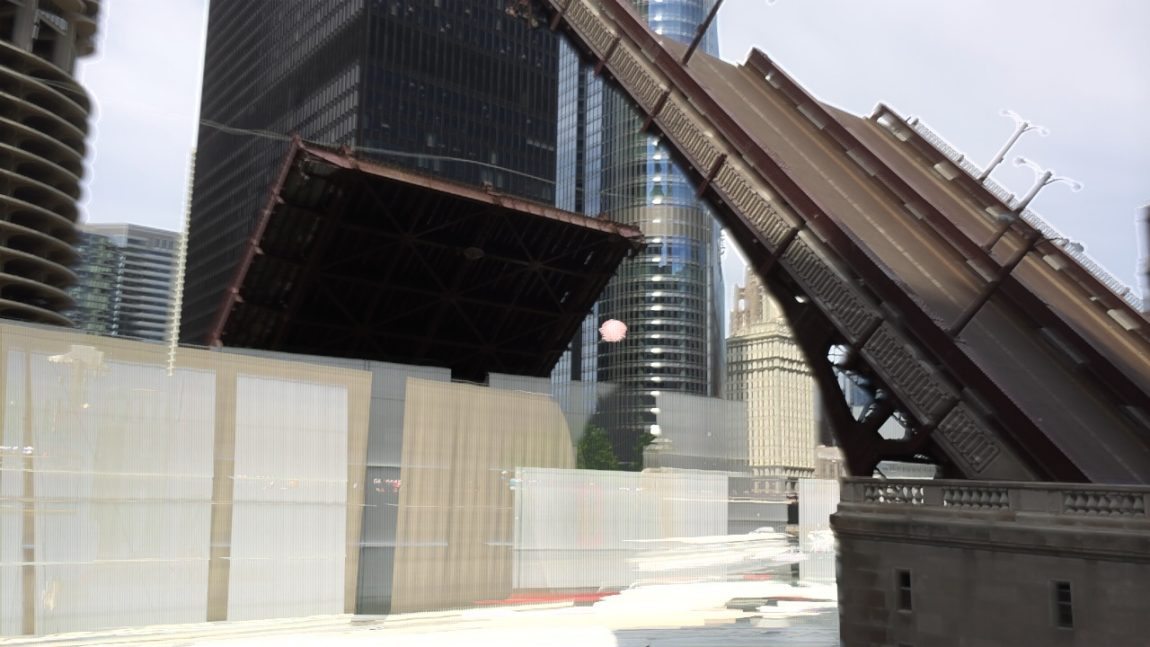
The trick with this app is that it doesn’t merely take a long exposure. Instead, it takes lots of micro photos throughout the time span. In this case, I shot for 15 seconds. It probably took 100 microphotos over those 15 seconds. Throughout those photos, any change in lighter objects will be marked on the image. That’s why the snow appears as dotted lines. A white car driving down the street would appear as white horizontal lines.
For comparison, here are a couple of images of sailboats going down the Chicago River.

An album for snowfall
As the snowflakes gently fell, my Spotify new music alerts give me a new winter album — “Minimalism for Winter” featuring Philip Glass, John Cage, and Arvo Pärt. This collection offers three hours and 45 minutes of immersive winter-themed music, perfect for a snowy day like today.
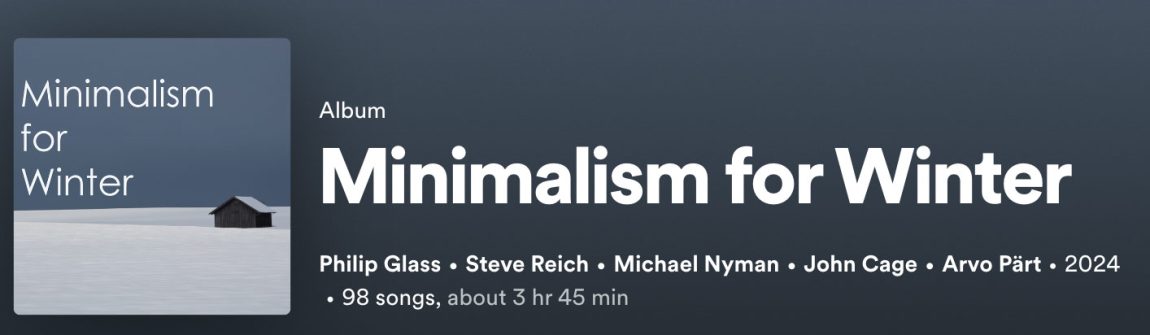
Listening to this album while watching the snowfall is a truly enchanting experience. Seeing Philip Glass, John Cage, and Arvo Pärt together in one album is pretty cool for me as I have a little bit of a history with each of these composers.
Arvo Pärt
Being of Estonian descent (my father moved to America when he was four), I feel a connection to Arvo Pärt, one of Estonia’s most renowned musicians. In 2019, I stumbled upon a giant portrait of Arvo Pärt in downtown Chicago. (Another notable Estonian artist is Vanilla Ninja. Imagine blending the styles of Arvo Pärt and Vanilla Ninja – what an intriguing mix that would be!)
Philip Glass
While I’m still on the hunt for Vanilla Ninja and Arvo Pärt mashups; today, I learned about some fascinating remixes of Philip Glass’s work.
During my college years, I was inspired by his repetitive structures to create art with rhythmic systems. One day, I’ll share some of my rhythm art from that era (1993-1997). To learn more about Philip Glass’s thoughts on art and vision, check out this article.
John Cage
John Cage, known for his concept of silence in art, was brilliantly captured in words by Lynne Tillman:
All day, men — no women — took the microphone and spoke. There was always a buzz in the audience, whispers, an audible hum of excitement. Then it was time for John Cage. He walked onto the stage and began to speak, without the microphone. He stood at the center of the small stage and addressed the crowd. He talked, without amplification, and soon people in the audience shouted, “We can’t hear you, use the mic. We can’t hear you.” John Cage said, “You can, if you listen.” Everyone settled down, there was no more buzz, hum or rustling, there was silence, and John Cage spoke again, without the microphone, and everyone listened and heard perfectly.
Long-exposure photography is like an exercise in silence. You stand behind your camera quietly and absolutely motionless, waiting for the camera to finish its exposure. Your camera is capturing the scene visually. But you, the photographer, stand there, listening to your scene. Listening to the silence.
In 2018, I used the Slow Shutter Cam app to capture a snowfall in downtown Chicago from the Chicago Tribune offices in Prudential Plaza – a moment of peaceful observation in a bustling city.
Another thought about John Cage. In college, we learned how John Cage used silence in music. Just like notes are in music, the moments between the notes are used. The comparison was drawn over to the visual arts with the negative space in a composition. Instead of always looking at the subject matter, look at the space around the subject matter, too.
More Slow Shutter photos, please!
Relish your opportunities having a window to the outside world while you work. I’ve been in a windowless environment for the past 15 years (not including WFH most of 2020 during COVID).
Yesterday I found in Adobe Lightroom that it tracks what iOS app made the image. Thus, I can do a search in Lightroom for all the photos I made with the “Show Shutter Cam” app.
However, this feature only started working when I got the iPhone SE in 2020. So all my photos prior to that aren’t searchable, because those older iPhones didn’t include the app name in the photo’s metadata.